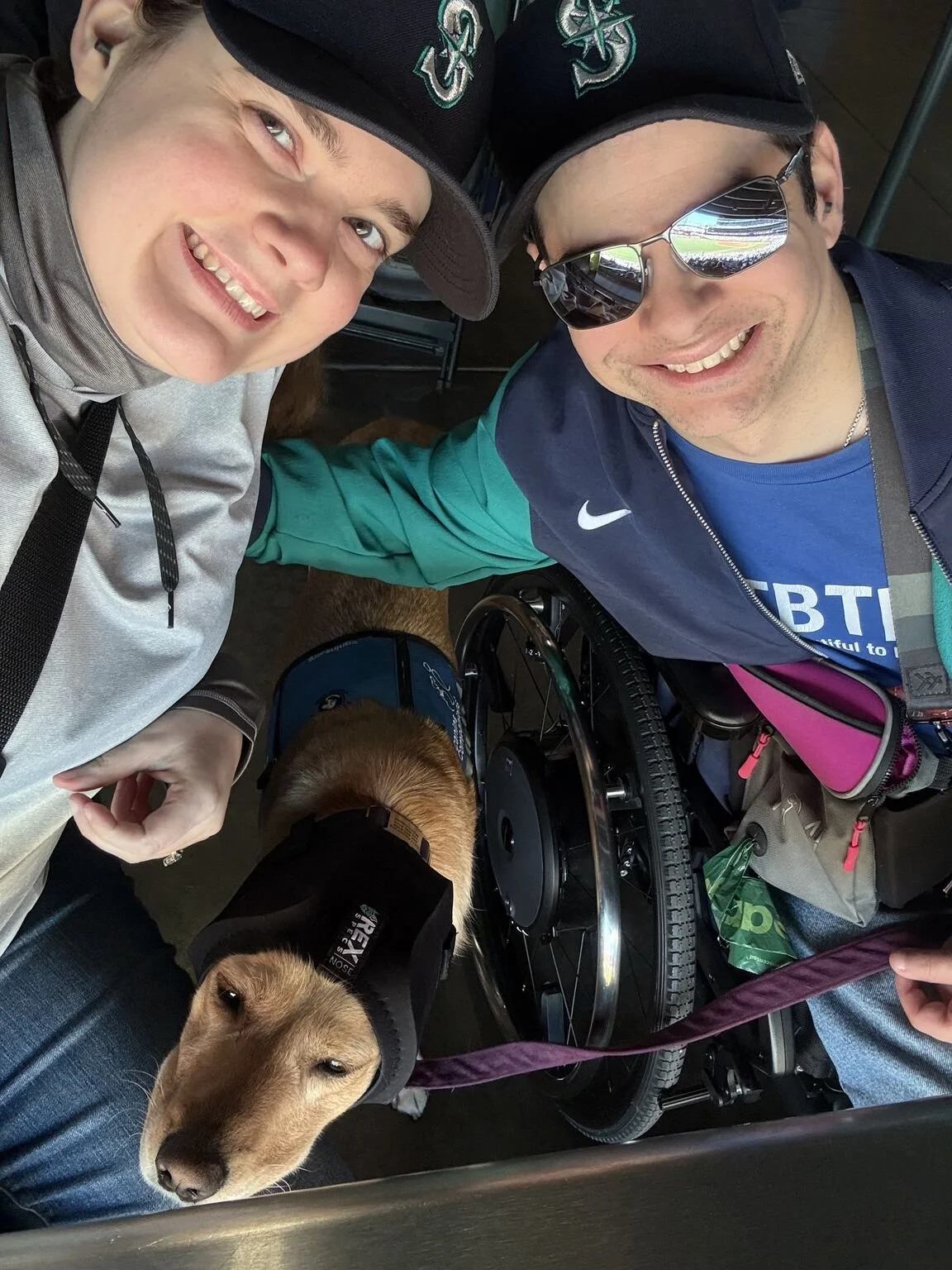
Ryan, his fiancée, and Lovey attend the Seattle Mariners game.
Yesterday’s Seattle Mariners game was just about everything you could ask for on the Fourth of July. Beautiful weather, a 4-0 win over the Toronto Blue Jays, and an afternoon at T-Mobile Park with my fiancée and Lovey, who was, as always, on her game. Thanks to Canine Companions®, we were able to spend the holiday there together, and by the end of the game I was already thinking what a great day it had been.
Like we usually do, we stayed in our seats for about 20 minutes after the final out. When you’re navigating a crowded stadium in a wheelchair with a working service dog, waiting for the crowd to thin out is the easiest way to avoid thousands of people moving in every direction while you’re trying to find a safe path out of the stadium.
While we were waiting, a young girl came over and asked if she could pet Lovey. I appreciated that she asked because that’s exactly what people should do. I explained that Lovey was working and that I couldn’t let anyone pet or distract her. She continued reaching toward Lovey anyway, and as I looked over, I noticed the woman who was with her holding up a phone.
My fiancée heard her say, “That’s okay. I got the picture.”
Before I even knew what had happened, there was already a picture of me and Lovey sitting on a stranger’s phone. I don’t know where that picture ended up or why she wanted it. What stayed with me was the realization that someone had already decided my consent wasn’t necessary.
Many disabled people experience versions of this all the time. Sometimes people touch our wheelchairs without asking. Other times they pet our service dogs, even after we’ve explained they’re working. Sometimes they take our picture because they find us, or our dogs, interesting.
On the surface those are different interactions. What they have in common is that someone else has decided our boundaries are optional.
That leaves disabled people in an impossible position. If we enforce a boundary, we’re often perceived as unfriendly. If we object after someone crosses it, we’re accused of overreacting. The attention quickly shifts away from the person who ignored the boundary and toward the disabled person who had the audacity to set one.
Disability doesn’t change the fact that we have the same right as anyone else to decide who touches us, who distracts our service dogs, and who photographs us. Being in public doesn’t mean we’ve given up our right to consent.
I don’t believe most people who do these things have bad intentions. I think many have simply never stopped to consider how it feels from the other side. That’s exactly why conversations like this matter.
So I’m curious. If someone you didn’t know started taking pictures of you simply because they found you interesting, would you expect them to ask first?
If your answer is yes, why should that expectation change because the person they’re photographing happens to be disabled?