Accessibility

Inclusion Only Works When You Mean It: The Numbers Behind Disability Employment

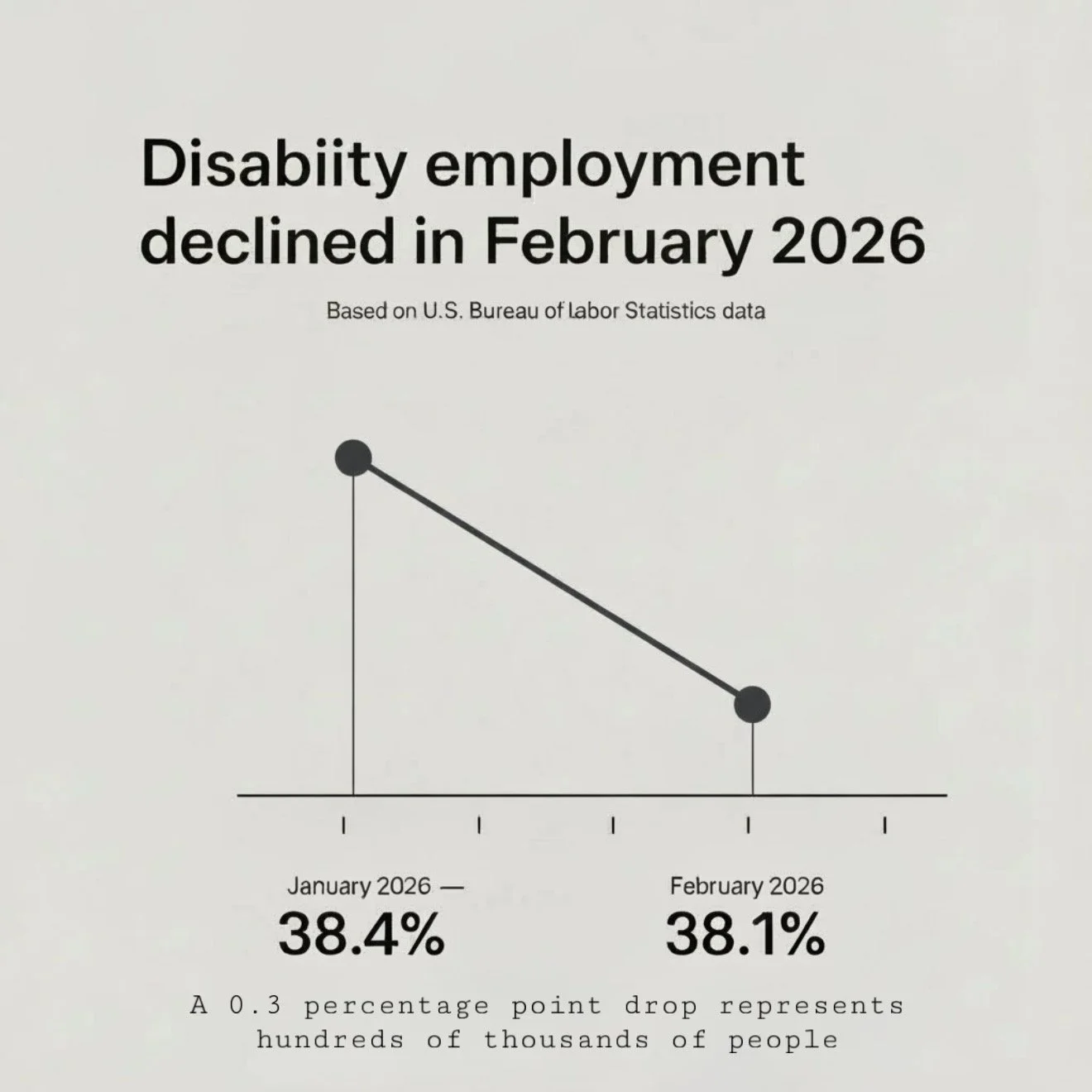
Line chart showing disability employment declining from 38.4% in January 2026 to 38.1% in February 2026, based on U.S. Bureau of Labor Statistics data, with note on a 0.3 percentage point drop.

Disability employment just dropped.

From 38.4% to 38.1% in one month.

That change represents hundreds of thousands of people losing ground in a single month, according to the latest nTIDE report from the Kessler Foundation based on data from the Bureau of Labor Statistics.

On paper, it looks small, just a fraction of a percentage point. In practice, it reflects movement in the wrong direction at the same time LinkedIn is full of companies talking about their commitment to inclusion.

For those of us who have been living in this space for a while, it feels predictable. This is what it looks like when inclusion is treated as messaging instead of something structural.

We get hired, and for a moment it looks like progress. Once we are inside the role, the reality starts to narrow. Job requirements that never quite made sense begin to matter, accommodations that were described as straightforward turn into drawn-out processes, and support that was implied becomes something that has to be justified repeatedly.

Over time, the system finds it easier to question us than to examine whether the environment was ever set up for success in the first place.

That is the part that does not show up in the celebration posts. It is also the part that explains the numbers. When people cannot get in, cannot stay, or cannot grow, the math does not hold.

Inclusion only works when you mean it. It does not work as a campaign or a metric. It works when leadership and infrastructure actually shift to support the people brought into the organization.

Right now, many organizations have not made that shift, and the data is reflecting that in real time. We feel it at every stage, when applications go unanswered, when more energy is spent fighting for access than doing the job itself, and when strong performance still leads nowhere.

We can continue to celebrate progress, but the numbers are telling a different story.

If inclusion begins to fall apart the moment it becomes inconvenient, what exactly are we building?

What Happens When Airlines Damage Wheelchairs? The Reality of Flying With A Disability

Every time I fly, I have to ask myself:

Will my wheelchair still work when we land?

Because airlines damage thousands of them every year.

As a wheelchair user, I’m handing over the piece of equipment that functions as my legs and hoping it comes back in one piece.

So I prepare in ways most people never have to think about. I travel with a laminated one-sheet explaining exactly how to handle my chair. I bring backups of everything. I carry a full binder for Canine Companions® Lovey, even though all of that has already been submitted ahead of time.

And even then, none of it guarantees anything.

This shows up clearly in what happened to Emily Ladau, whose $75,000 custom wheelchair was severely damaged after a Delta Air Lines flight, as reported by USA TODAY and Zach Wichter.

Stories like this feel shocking if you’re new to it. If you live in this reality, they don’t. They feel familiar.

People often point to the numbers and say about one percent of wheelchairs are mishandled, which sounds small until you actually translate what that means. Because if there were a one percent chance your legs would be broken when you got off a plane, you wouldn’t call that acceptable risk. You would question whether the system is safe at all.

Wheelchairs aren’t luggage. They aren’t interchangeable.

They are how we move through the world.

When they’re damaged, the question shifts from “how was your trip?” to “how are you going to function now?”

If you break someone’s wheelchair, you didn’t damage their property. You took away their ability to move.

The uncomfortable reality is that stories like Emily’s get traction because she has a platform. Most people don’t, which means this is happening every day to people who don’t have the visibility to force a response, and who are left dealing with the fallout on their own.

We’ve been talking about this for years. There has been real advocacy, real momentum, even policy movement. Yet the system still treats essential mobility equipment like cargo and fixes problems only after they happen.

If you knew there was a real chance your ability to move could be taken from you at the end of a flight, would you still see this as acceptable risk?

Lyft Agrees On Settlement After Service Dog Ride Denials

Disability advocate Ryan Honick reacts to a new Lyft settlement after a blind college student, Tori Andres, was repeatedly denied rides because of her service dog.

Yesterday I joined CBS News to talk about a new Lyft settlement after Tori Andres was repeatedly denied rides because of her service dog, Alfred.

If I ever get the chance to meet her, the first thing I’d say is thank you.

Speaking up about discrimination takes courage, and it helps highlight a pattern that service dog teams have been documenting for years.

Service dogs like Alfred and Canine Companions® Lovey are our medical equipment with a heartbeat and our access partners in a world still too often built without us in mind.

Accountability like this is how change starts.

Thank you to Jennifer Williams and the entire CBS team for amplifying disabled voices and helping move the conversation toward real access and equity.

More People Are Asking For Accommodations—That's A Good Thing

Female college student sits in a library composing a paper. She appears tired with her hand on her forehead.

I’m bone tired. Tired in a way that comes from realizing the fight for access never actually ends. It just changes locations.

It starts in school, when you learn that if your disability isn’t obvious, you have to document every inch of it, defend it to people who aren’t medical professionals, and then brace yourself for the moment you’re approved but quietly judged anyway. I learned early that asking for what I was legally entitled to somehow made my education “less fair,” as if my access diluted the value of the degree instead of making it possible for me to earn it in the first place.

You carry it into adulthood, into workplaces where you are expected to be calm, articulate, strategic, and endlessly patient while proving you deserve the same tools everyone else takes for granted. If you’re competent, people assume you don’t really need accommodations. If you ask for them anyway, the narrative shifts to unfair advantage. You’re working twice as hard with fewer margins, and still managing other people’s comfort.

Today, two headlines landed at the same time. Keely Cat-Wells, founder of Making Space wrote in Forbes that disabled talent is one of the largest untapped workforces in the country, and that leaving us out is no longer just an equity issue but an economic one. We’re used to surviving and thriving in spaces that aren’t built for us, and so we bring unique solutions to the table. Preston Fore at Fortune meanwhile, focused on the rise in college students seeking disability accommodations, calling it a "phenomenon."

These stories are connected in a way many may not see.

More people asking for accommodations does not mean the system is being abused. It means stigma is finally loosening its grip. It means people are learning the language of their rights and realizing they don’t have to suffer quietly to belong. Accommodations are the difference between access and exclusion.

The real problem is not that too many people need accommodations. The problem is that we still treat access like a moral test instead of a design decision.

If we actually care about the future of work, we need to stop asking whether access is fair and start asking why it was ever optional in the first place. Accommodations are not burdens and they are not unfair advantages. They are lifelines that ensure equity and access.

Not All Disabled Leaders Are Allies, And That’s the Conversation We Need to Have

A man in a wheelchair sits in a doorway high on a dark glass skyscraper, kicking away a golden ladder as pieces fall toward a crowd of people reaching upward beneath stormy skies.

As October wraps up, I keep circling back to something we rarely say out loud: not all disabled people are allies.

John Oliver once joked on HBO Last Week Tonight about former Rep. Madison Cawthorn that “being an asshole is truly accessible to everyone.” He wasn’t wrong. We like to assume disabled leaders automatically champion the disability community, that lived experience guarantees empathy.

But it doesn’t.

Governor Greg Abbott, a wheelchair user, has consistently pushed policies that harm disabled Texans. Senator John Fetterman, once celebrated for normalizing assistive technology and comfortable clothing on the Senate floor, now carries the label “Trump’s favorite Democrat.” Representation does not always translate to advocacy. Sometimes it just makes the betrayal sting more.

And I have seen that same pattern play out closer to home. Early in my federal career, when I first needed a telework accommodation, I turned to a senior colleague who was a respected disability advocate. I expected empathy. Instead, he looked me straight in the eye and said, “Keep your head down. Don’t fight this.”

That moment never left me. It might have been practical advice, but it was not allyship.

It taught me that proximity to power is not the same as solidarity, and that some of the hardest lessons come from people who should have known better.

We love to talk about inclusion in the workplace. The posters. The hashtags. The polished commitments to mental health and belonging. But the moment someone actually uses those systems, asks for flexibility, PTO, or an accommodation, the tone shifts. Suddenly inclusion has an asterisk. Suddenly the same people preaching wellness start whispering about fairness and team morale.

Genuine allyship is not about the company newsletter or the press release in October or the panel during Disability Pride Month. It is about the quiet, consistent work of believing people when they tell you what they need, without making them prove it. It is about creating systems where asking for help does not feel like a liability.

There is a hierarchy in disability culture we do not talk about enough. The visible versus the invisible. The acceptable versus the difficult. The wheelchair user makes a great photo op. The employee with PTSD, chronic pain, or neurodivergence gets side-eyed for needing too much. Passing privilege is real, and too many use it to climb the ladder only to kick it down behind them.

Having a disability does not make someone an ally. It does not even make them kind. Sometimes it just makes them powerful enough to prove they are not.

If allyship means anything, it is how we act when no one is watching, especially toward each other.

What It Took to Get to the DOJ v. Uber Lawsuit

A close-up of a person holding a smartphone displaying the Uber app logo. The phone is held in one hand inside a vehicle.

I’ve been denied rides with my service dog more times than I can count.

Not because I was unclear. Not because the law wasn’t on my side. But because a driver could take one look at us and decide: nope. And Uber, no matter what it says in press releases, let them.

Over the years, drivers have challenged me to file complaints, knowing nothing would happen. And they were mostly right. I started documenting the rejections publicly in 2018. I called it “rejection time,” the extra hour I’d build into my schedule just to find a driver who wouldn’t leave me at the curb.

If I needed to be somewhere at 1pm, I’d call a ride by noon. Not because the drive took that long, but because I had to plan for the fight.

Once, before Uber Pet was even a backup option, I was in such a rush I paid for an Uber Black. It cost exponentially more than UberX, just to avoid being denied again. I paid a premium to be treated like I belonged.

This wasn’t rare. It was weekly. Sometimes daily. And when I shared my experiences, the pushback came fast:

“You’re overreacting.”
“Maybe try Uber Pet.”
“Why didn’t you just leave the dog at home?”

Lovey isn’t a pet. She’s a highly trained service dog from Canine Companions®. She’s my access partner. Before her, it was Pico, my first service dog, who stood next to me through the worst of this. I still wish his name could be in the court record.

On Thursday, the U.S. Department of Justice filed a lawsuit against Uber for violating the ADA, denying rides to people like me. My name is in the complaint. CBS News covered it and quoted me saying what I’ve felt for years:

“The incidents are not isolated, but evidence of a widespread civil rights failure.”

“No one should be forced to choose between their mobility and their legal rights.”

It’s validating to be heard. But also exhausting that it took this long.

This lawsuit isn’t just about one company. It’s about a culture of compliance theater that leaves disabled people behind. And then expects us to be grateful for the ride when it finally shows up.

What I want now is simple: real enforcement. Not just good PR. Because access isn’t a suggestion. It’s the floor.

If you’ve never had to schedule rejection time, count yourself lucky. If you have, I see you.

And I hope you’ll answer this:

When have you had to shrink yourself just to get through the day?

What does accountability look like where you work, not just in writing, but in action?

Uber denies rides to passengers with disabilities, Justice Department claims in lawsuit

Disability Accommodations at Work: Why Employees Fear Speaking Up

A diverse group of professionals, including wheelchair users and employees with headphones, collaborate in a modern office, promoting workplace inclusion and accessibility.

Who gets to be "disabled enough"?

That’s the uncomfortable debate unfolding in workplaces across the country—and one I recently discussed in The Wall Street Journal alongside Justina Plowden and Keely Cat-Wells.

As more employees request accommodations, some worry we’re stretching the definition of disability too far. But here’s the real question: Are we diluting the meaning of disability, or are we finally acknowledging the full spectrum of barriers people face?

Here’s where I stand: Pitting disabilities against each other is dangerous. It’s not up to me, an employer, or anyone else to decide whose disability is “valid enough” to deserve support. If someone says they need an accommodation, believe them. Full stop.

And yet, many disabled employees don’t feel safe disclosing their disability at all. Why? Because they know what happens next:

🚫 They’re seen as less competent.
🚫 They’re overlooked for promotions.
🚫 They’re often the first to go in layoffs.

This is why so many people don’t ask for accommodations, even when they’re legally entitled to them. It’s not simply that remote work itself makes disabled employees more vulnerable—it’s that stigma and workplace bias make disclosing a disability a risk.

I appreciate WSJ and Callum Borchers for giving space to this conversation, and I hope it pushes more employers to rethink how they support disabled workers—both those who disclose and those who don’t.

Disabled Workers Debate Who Is Really One of Us

Federal Workforce Cuts Are Coming—And Disabled Employees Are the First to Go

Elon Musk, with his son X Æ A-Xii, speaks with President Donald Trump and reporters in the Oval Office at the White House on Tuesday.

When the now infamous “buyout” offer hit my inbox a few weeks ago, I was dumbfounded. Just type, ‘resign’ in the body of the e-mail and we’ll pay you through September. It’s that easy!

I’ve seen Nigerian princes put more energy into their scams.

Federal employees like me—many of whom are disabled—are being left in limbo as the latest executive orders attempt to gut the federal workforce under the guise of “efficiency.” The latest round of chaos?

👉 A deferred resignation program designed to “persuade” employees to quit, which a judge has already paused due to legal challenges.
👉 A hiring freeze that mandates one new hire for every four who leave—essentially ensuring agencies shrink rapidly, with no plan to sustain essential functions.
👉 Agencies signaling they may reevaluate reasonable accommodations, adding yet another layer of red tape for disabled employees who already face enough hurdles.

These executive orders aren’t about “efficiency.” They are designed to break the civil service. And disabled employees—who rely on accommodations to do their jobs—are among the most vulnerable.

A judge temporarily paused the deferred resignation program after unions representing 800,000 civil servants called it an “arbitrary, unlawful, short-fused ultimatum,” according to The Washington Post. Yet OPM is still pushing it, with the White House calling it a “very generous, once-in-a-lifetime offer.”

This administration has already been slapped down in court multiple times for executive overreach. Trump’s orders gutting birthright citizenship, freezing federal grants, and mass-firing USAID employees have all been blocked. That doesn’t stop them from trying.

When agencies need to cut positions fast, who gets targeted first? The
answer isn’t theoretical—it’s happening now:

✅ Federal workers with disabilities already face disproportionate scrutiny. Any reevaluation of accommodations means we’ll have to fight harder just to keep the support we already have.
✅ Layoffs disproportionately harm disabled employees who may have fewer opportunities to find comparable private-sector jobs with the same level of accessibility.
✅ The rhetoric doesn’t match reality. They claim this is about “efficiency,” but efficiency doesn’t look like forcing out experienced professionals while agencies struggle with understaffing.

As one EEOC lawyer put it:

“OPM’s breezily condescending emails don’t mention federal ethics laws at all. They’re either intentionally lying to us or didn’t bother to do basic research. Either way, they can’t be trusted.”

I have been a federal employee, a disability advocate, and a firsthand witness to the barriers disabled people face in the workplace. If these executive orders move forward unchallenged, we will see an exodus of talented, dedicated disabled professionals—pushed out not because we can’t do the job, but because bureaucracy is being weaponized against us.

Trump executive order vows substantial cuts to federal workforce

DEI is Under Attack—But Inclusion Can’t Be Optional

A modern office features an illuminated sign reading "Diversity, Equity, and Inclusion: Strength in Unity" with a colorful gradient background. In the background, a diverse group of employees collaborates around a conference table in a well-lit space with large windows.

Every day, I watch as the policies meant to ensure my dignity, my inclusion, and frankly, my survival, get dismantled. It’s not hypothetical. It’s not a distant issue. It’s personal.

Like many disabled professionals, I see the writing on the wall—diversity, equity, and inclusion are under attack in ways that go beyond policy changes. These aren’t just bureaucratic shifts; they send a chilling message about whose existence is valued and whose is not. And for so many of us, that message is hitting hard.

But here’s what I also know: not everyone is backing down. Not every company, every leader, every organization is willing to let progress be erased. Some including Apple, Microsoft, Delta Air Lines, Johnson & Johnson , and JPMorganChase are doubling down, choosing to be louder, more intentional, more committed to inclusion than ever before. And if you’re one of those people—if you believe that workplaces should be places of opportunity for everyone, not just the most privileged—then now is the time to act.

I’ve spent my career navigating the intersections of disability, policy, and workplace equity. I don’t just speak about inclusion—I live it. And I know firsthand what it takes to create workplaces where disabled professionals don’t just survive but thrive.

If your company, conference, or organization is still committed to real DEI—not just as a buzzword, but as a practice—I want to talk. Hire disabled speakers. Bring in disabled consultants. Invest in perspectives that aren’t just theoretical but lived. Because right now, at a time when so many of us feel like our voices are being pushed aside, inclusion can’t just be a quiet value. It has to be a loud, unwavering action.

Linkedin Rewind: 2024 A Year In Review

Here's my 2024 LinkedIn Rewind, by Coauthor.studio and Hunch:

2024 was the year disability employment hit its highest rate since tracking began - 22.5% - but for me, it was also the year I said goodbye to my greatest advocacy partner, Pico.

This year reminded me that advocacy isn't just about statistics. It's about the relationships that drive change, the partnerships that challenge systems, and the deeply personal journeys that transform workplaces.

At the U.S. Department of Labor, I've watched our work translate into tangible progress. But some of the most profound changes happen in moments you can't measure - like how Pico transformed how I moved through the world and how I advocate.

Key achievements that defined my year:

Professional Impact:
• Advanced accessibility policies within federal workforce
• Published influential pieces challenging AI hiring practices
• Continued driving systemic changes in workplace inclusion

Personal Growth:
• Navigated Pico's retirement and subsequent passing
• Continued as Brand Ambassador for Canine Companions® for Independence
• Maintained advocacy momentum through personal transitions

Three posts that resonated most with our community:

1. "A Goodbye to Pico"
Reflecting on how a service dog is more than a companion - they're a partner in advocacy.
"He made me a better human, a better advocate, and someone who could navigate the challenges of the world with confidence."
https://bit.ly/4a1msBj

2. "Biden's Impact on Disability Employment"
Highlighting concrete policy changes driving real improvements.
"The employment-population ratio for people with disabilities hit 22.5% - the highest since the Bureau of Labor Statistics started tracking this data in 2008."
https://bit.ly/3ZXCOqj

3. "The Shifting Landscape of Disability Employment"
Exploring how remote work transforms employment opportunities for disabled professionals.
https://bit.ly/3ZUI6CR

Looking ahead to 2025: My focus remains bridging policy and practice, particularly in emerging areas like AI hiring and remote work policies that directly impact the disability community.

To Pico, my colleagues, and the entire disability advocacy community: Our work continues. Our impact grows. And we're just getting started.