
Every time I fly, I have to ask myself:
Will my wheelchair still work when we land?
Because airlines damage thousands of them every year.
As a wheelchair user, I’m handing over the piece of equipment that functions as my legs and hoping it comes back in one piece.
So I prepare in ways most people never have to think about. I travel with a laminated one-sheet explaining exactly how to handle my chair. I bring backups of everything. I carry a full binder for Canine Companions® Lovey, even though all of that has already been submitted ahead of time.
And even then, none of it guarantees anything.
This shows up clearly in what happened to Emily Ladau, whose $75,000 custom wheelchair was severely damaged after a Delta Air Lines flight, as reported by USA TODAY and Zach Wichter.
Stories like this feel shocking if you’re new to it. If you live in this reality, they don’t. They feel familiar.
People often point to the numbers and say about one percent of wheelchairs are mishandled, which sounds small until you actually translate what that means. Because if there were a one percent chance your legs would be broken when you got off a plane, you wouldn’t call that acceptable risk. You would question whether the system is safe at all.
Wheelchairs aren’t luggage. They aren’t interchangeable.
They are how we move through the world.
When they’re damaged, the question shifts from “how was your trip?” to “how are you going to function now?”
If you break someone’s wheelchair, you didn’t damage their property. You took away their ability to move.
The uncomfortable reality is that stories like Emily’s get traction because she has a platform. Most people don’t, which means this is happening every day to people who don’t have the visibility to force a response, and who are left dealing with the fallout on their own.
We’ve been talking about this for years. There has been real advocacy, real momentum, even policy movement. Yet the system still treats essential mobility equipment like cargo and fixes problems only after they happen.
If you knew there was a real chance your ability to move could be taken from you at the end of a flight, would you still see this as acceptable risk?
Don't Push My Wheelchair: Unsolicited "Help" At The Airport Isn't Help
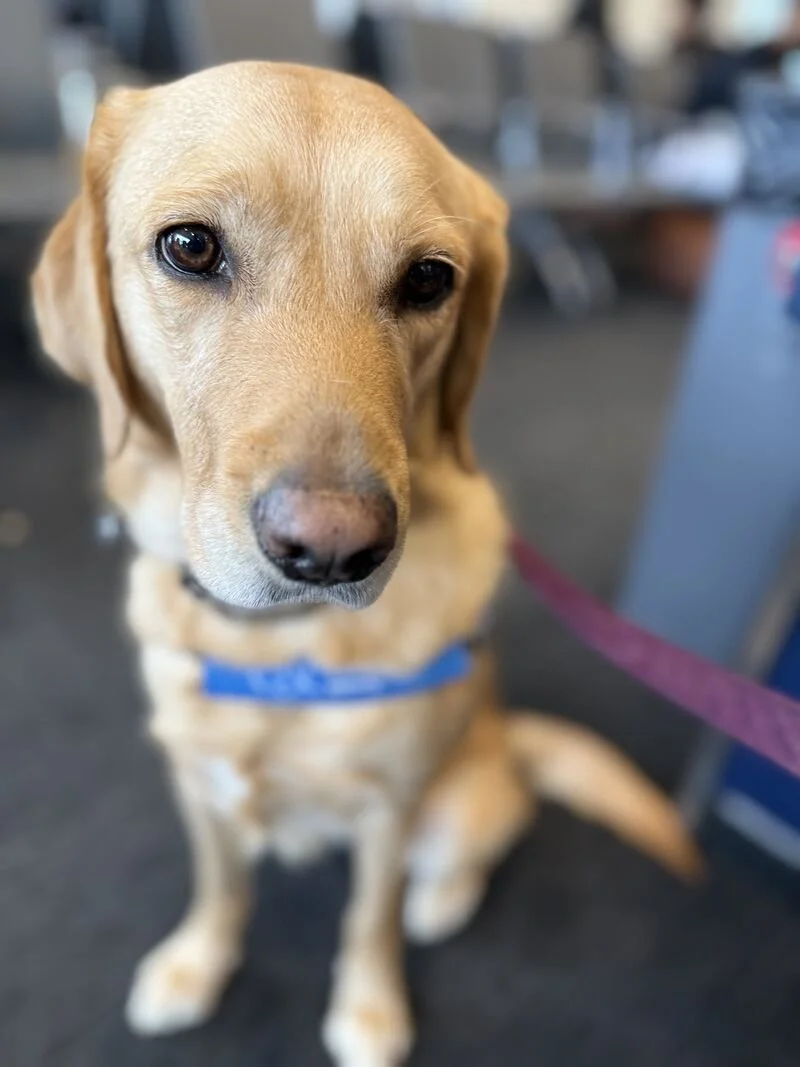
Close-up of Lovey, a yellow Labrador service dog sitting calmly in an airport terminal, looking directly at the camera; a blue Canine Companions service vest and purple leash are visible, with the background softly blurred
A stranger grabbed my wheelchair at LAX.
And started pushing me.
No “Do you want help?”
No “Hey, can I give you a hand?”
Just hands on my chair. And suddenly I’m moving.
Last week, I was in LA for my best friend’s 40th.
Early. Loud. Crowded. Lines are long and everyone wants to get to their gate.
I’m in my chair. My girlfriend’s with me. Canine Companions® Lovey, is working. We have a rhythm, a pace that’s ours. I know her speed. She knows mine.
And then, it happened.
A stranger saw me pushing up an incline and decided, without asking, that they were going to “help.”
My chair isn’t a shopping cart. It’s not luggage. It’s not a stroller you can grab when you’re feeling helpful.
It’s an extension of my body.
So when you grab my chair without consent, you’re not “assisting.” You’re touching me. You’re moving me. You’re taking control of my body in public.
My body knows it before my brain finishes the sentence.
There’s this sensory shock the second someone touches my chair, especially from behind, because suddenly I’m moving at a pace I didn’t choose.
Which means Lovey is suddenly moving at a pace I didn’t choose.
Which means the most trained, steady, brilliant dog on the planet has to recalibrate in real time because a stranger decided they know better than her handler.
It’s disorienting. It’s dangerous. And yeah, it makes my blood boil.
On top of the violation, there’s the performance.
Because in that moment, I’m not just thinking:
• Stop this now
• Keep Lovey safe
• Keep myself stable
• Keep my girlfriend safe
• Don’t get clipped by the river of people rushing past
• Don’t escalate in a public space at 6 a.m.
• Don’t become “the angry disabled guy” in somebody’s little morality play about “helping”
So what did I want to say? Honestly?
What the f— are you doing? Get your hands off me.
But I don’t have the social luxury to say it the way my nervous system wants to say it. The second you push back, it becomes:
“Wow. I was just trying to help.”
And now I’m the problem.
People can mean well and still do harm. Good intentions don’t grant permission. Kindness doesn’t override consent. “Help” that takes autonomy is a takeover.
For the record, I bought my chair without handles on purpose. Years ago. Intentionally. Because I’ve lived this before. I tried to build boundaries into the design.
And still, people find a way.
The issue isn’t the handles. It’s the assumption. The entitlement that says, “I get to decide what you need.”
Here’s my ask:
If you see a disabled person struggling, ask. If you want to help, ask.
And if you don’t get a yes?
Don’t touch. Don’t push. Don’t grab. Don’t steer.
Autonomy isn’t a nice-to-have. It’s the whole point.
Why Being Disabled Is Not A Travel Hack
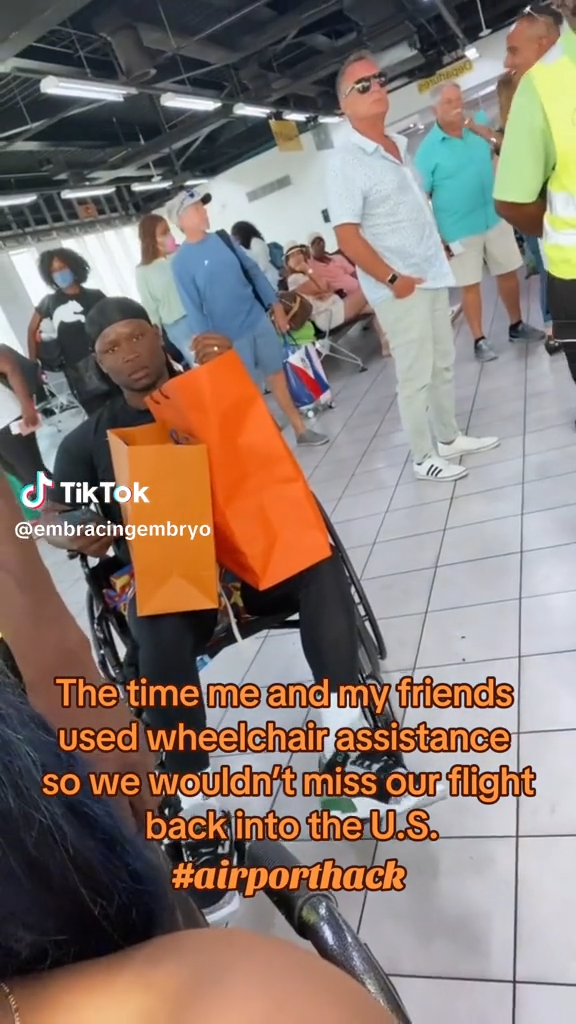
Freeze frame of a TikTok video with the caption “The time me and my friends used wheelchair assistance so we wouldn’t miss our flight back into the U.S.”
Happy 2026. Feeling pumped?
Everyone’s doing their New Year reset. “We’re gonna be better.” And disabled people are waking up to TikTok's about how being disabled is a travel hack and The Wall Street Journal highlighting the miracle of ‘Jetway Jesus.’
Being disabled is not travel hack. Flying while disabled is exhausting. It’s dehumanizing. It’s expensive. And it’s layered in ways most people never have to think about.
When I travel, I don’t just show up with a boarding pass. I travel with a wheelchair, and a printed, double-sided one-sheet I hand to every gate agent explaining how to handle it. Because I’ve answered the same questions a thousand times, and I’m tired of watching people guess with equipment my body depends on.
I travel with my service dog, Canine Companions® Lovey. Which means paperwork. Digital copies. Physical copies. Backups for the backups. Because I never know who’s going to demand proof, or what form of proof will suddenly be “required” today.
That’s before I even get to my body. The pain, the fatigue. the logistics. Whether my girlfriend is with me to help. What if something breaks? Will anyone listen? Just how tired am I going to be by the time we land? How much longer am I waiting to deplane? I’ve been sitting for hours with non-accessible airplane bathrooms.
So when I see people openly bragging about faking disability for pre-boarding or using their platforms to call it a “hack”, my brain short-circuits.
This feeds a narrative disabled people have been fighting forever:
• we’re exaggerating.
• we’re gaming the system.
• we need to be watched.
And yes—non-visible disabilities are real. They are valid. We should never be policing people who need assistance but don’t “look disabled enough.”
This is people who know they don’t need it, saying so out loud, and monetizing it for clicks. And the fallout lands on us.
On the scrutiny when someone like me stands up out of a wheelchair.
On the unspoken question: Are you faking it?
So we over-perform legitimacy. We carry more documentation. We explain more than we should. We make ourselves calmer, nicer, because access feels conditional.
I don’t want to spend my energy explaining why basic decency is required.
I want to spend it reminding people that disabled folks matter. That we’re not inspiration. Not content. Not a punchline. Not a workaround.
We’re just people trying to get where we’re going.
If this is how we’re starting 2026? Arguing about whether disability is being “abused”—then yeah. I’m frustrated. And I’m not interested in pretending this is cute or funny.
So I’ll ask this instead:
Who gets believed?
Who gets blamed when systems fail?
And why is disabled existence still treated like an inconvenience people feel entitled to exploit?
Sit with that.