
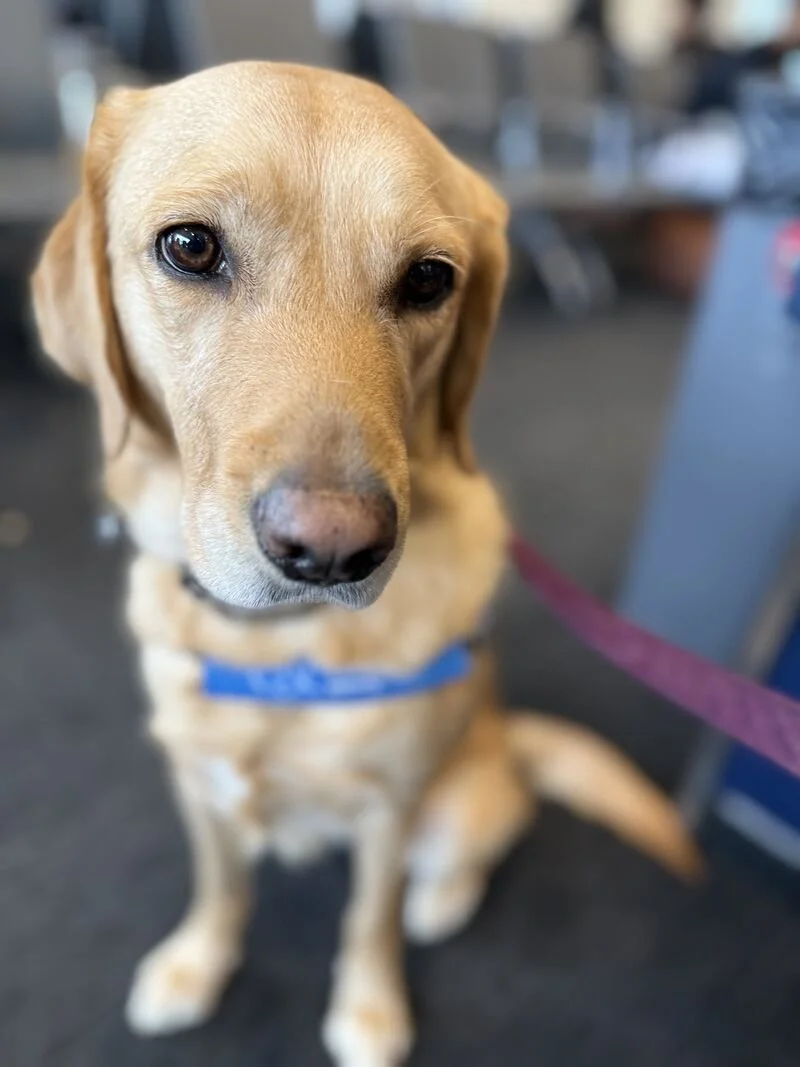
Close-up of Lovey, a yellow Labrador service dog sitting calmly in an airport terminal, looking directly at the camera; a blue Canine Companions service vest and purple leash are visible, with the background softly blurred
A stranger grabbed my wheelchair at LAX.
And started pushing me.
No “Do you want help?”
No “Hey, can I give you a hand?”
Just hands on my chair. And suddenly I’m moving.
Last week, I was in LA for my best friend’s 40th.
Early. Loud. Crowded. Lines are long and everyone wants to get to their gate.
I’m in my chair. My girlfriend’s with me. Canine Companions® Lovey, is working. We have a rhythm, a pace that’s ours. I know her speed. She knows mine.
And then, it happened.
A stranger saw me pushing up an incline and decided, without asking, that they were going to “help.”
My chair isn’t a shopping cart. It’s not luggage. It’s not a stroller you can grab when you’re feeling helpful.
It’s an extension of my body.
So when you grab my chair without consent, you’re not “assisting.” You’re touching me. You’re moving me. You’re taking control of my body in public.
My body knows it before my brain finishes the sentence.
There’s this sensory shock the second someone touches my chair, especially from behind, because suddenly I’m moving at a pace I didn’t choose.
Which means Lovey is suddenly moving at a pace I didn’t choose.
Which means the most trained, steady, brilliant dog on the planet has to recalibrate in real time because a stranger decided they know better than her handler.
It’s disorienting. It’s dangerous. And yeah, it makes my blood boil.
On top of the violation, there’s the performance.
Because in that moment, I’m not just thinking:
• Stop this now
• Keep Lovey safe
• Keep myself stable
• Keep my girlfriend safe
• Don’t get clipped by the river of people rushing past
• Don’t escalate in a public space at 6 a.m.
• Don’t become “the angry disabled guy” in somebody’s little morality play about “helping”
So what did I want to say? Honestly?
What the f— are you doing? Get your hands off me.
But I don’t have the social luxury to say it the way my nervous system wants to say it. The second you push back, it becomes:
“Wow. I was just trying to help.”
And now I’m the problem.
People can mean well and still do harm. Good intentions don’t grant permission. Kindness doesn’t override consent. “Help” that takes autonomy is a takeover.
For the record, I bought my chair without handles on purpose. Years ago. Intentionally. Because I’ve lived this before. I tried to build boundaries into the design.
And still, people find a way.
The issue isn’t the handles. It’s the assumption. The entitlement that says, “I get to decide what you need.”
Here’s my ask:
If you see a disabled person struggling, ask. If you want to help, ask.
And if you don’t get a yes?
Don’t touch. Don’t push. Don’t grab. Don’t steer.
Autonomy isn’t a nice-to-have. It’s the whole point.