
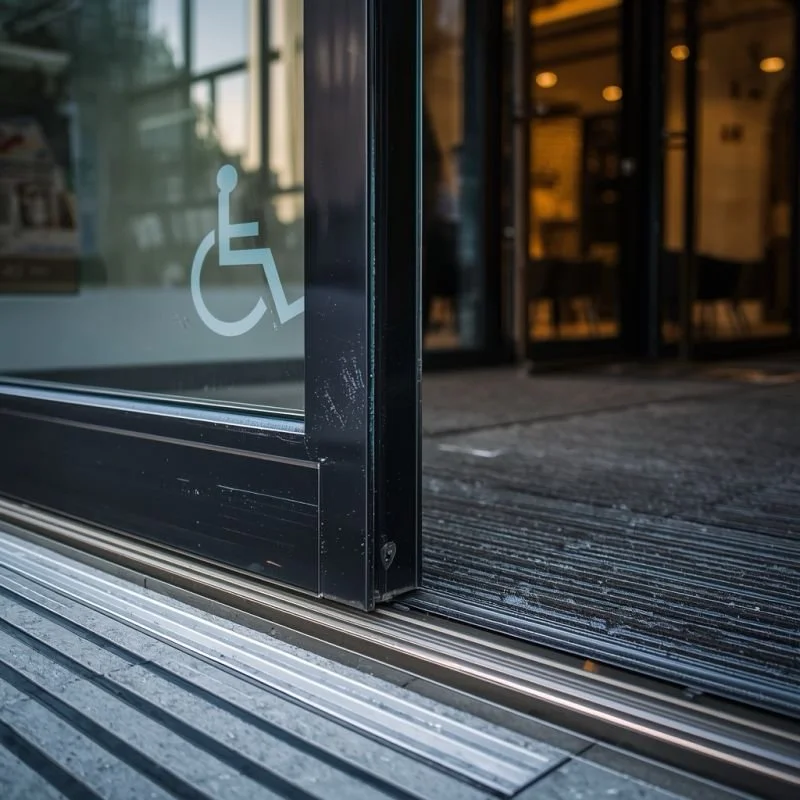
Close-up of a hotel entrance showing a glass door with a wheelchair accessibility symbol and a raised metal threshold that creates a small lip between the ramp and the doorway.
We booked an accessible hotel room.
The first thing I encountered was a barrier.
Over the weekend, we stayed at the Holiday Inn for a conference.
The first thing I felt when I pushed against the door wasn’t anger. It was, “I’m not even surprised.”
I’ve been disabled my entire life. I’ve learned that “accessible” means different things to different people despite the ADA has existed for basically my entire adult life. So when that door required real force—not “solid door” force, but you might need a second human force—I just thought, okay. We’re going to have one of those stays.
After a three-hour drive, all I wanted was to lie down.
Instead, from the literal threshold, I’m negotiating.
Then the shower bench. It wasn’t securely bolted. We joked that it was “spiritually bolted” to the wall. We reported it. They thanked us for being proactive. It was never fixed.
Everything after that just layered on.
Key cards replaced four times. You have to insert the key card into a slot to keep the electricity on. So when your key fails, your lights fail.
The button outside the room that said “handicap room.”
Housekeeping never came once in three days. Which, sure, maybe that’s operational chaos. But when you’re paying for a hotel because you’re conserving energy for a conference, and instead you’re managing your own environment on top of everything else, that’s another thing to carry.
That’s the part people don’t see.
Every detail required effort. Reporting the bench. Swapping the keys. Chasing down room service hours that had changed but “just weren’t updated.” Advocating for late checkout. Verifying loyalty membership.
I didn’t sleep well. I was more tired than I wanted to be at a conference I cared about. I wasn’t just attending, I was managing. Managing logistics, safety. frustration. Managing myself because Canine Companions® Lovey is always watching me, always tuned to my tension. I can’t just lose it. The leash carries that.
So I find humor first. I always do. It’s how I survive it. Underneath that humor is something else.
Accessibility isn’t a label. It’s operational, and It’s part of organizational culture and leadership.
If disabled voices aren’t present throughout all levels of your organization, these misses keep happening, not because people are malicious, but because they don’t know what they don’t know. And they don’t feel what they don’t have to feel.
A non-disabled colleague might describe that stay as “fine.” Underwhelming, maybe. But fine. For me, it was a weekend of negotiation layered on top of a professional commitment.
That’s the hidden tax.
I don’t speak for every disabled person. Our needs are different. But there should be a baseline. There should be a mechanism to correct. There should be accountability when someone says, “This isn’t safe.”
What I saw wasn’t hostility but preventable friction.
That is where leadership lives.
