Inclusion

AI Is Changing the Future of Work. Disabled Workers Already Know What That Feels Like.

A large robotic hand lifts a small human figure in a suit by the back of his jacket and drops him toward a wire wastebasket filled with crumpled paper. The background is a flat bright blue.

Everywhere I look, people seem afraid of becoming irrelevant thanks to AI.

Disabled people know that feeling better than anyone. We've lived in that tension our entire lives. Alice Wong called us the oracles. She was right. We learned to read the world differently because the world was never built with us in mind.

AI can close the gap or blow it wide open. I see signs of both already.

On one hand, technology has always been the thing that lets me move through a world that was not designed for my body or my needs. Uber, Instacart, Amazon, remote work, every one of these tools expanded my independence. AI has joined that list. It sharpens my thinking, helps me get unstuck, and pushes me to see ideas from angles I might have missed. It never replaces my judgment, but it challenges me in a way that feels useful.

While the tools have improved, the system around them has not. Disabled unemployment is at 8.7%, still nearly twice the national average according to the latest jobs report from the Bureau of Labor Statistics. That's partially due to AI-driven hiring systems screening out candidates before a human ever sees a résumé. Systems built on training data that rarely includes disabled people. They are shaped by teams who often do not understand disability, workplace bias, or accessibility in practice. When the ground shifts, we tend to be the first ones hit.

I want people to understand that AI is neither miracle nor menace. It is a force multiplier amplifying whatever framework you build around it. If the framework is inequity, then inequity scales. If the framework is access, then access grows.

The real danger is creating the future of work without the people who need these tools the most.

What are you noticing in the workplace as AI becomes part of your workflow?

Inclusion Isn't A Debate: Why SHRM Got It Wrong

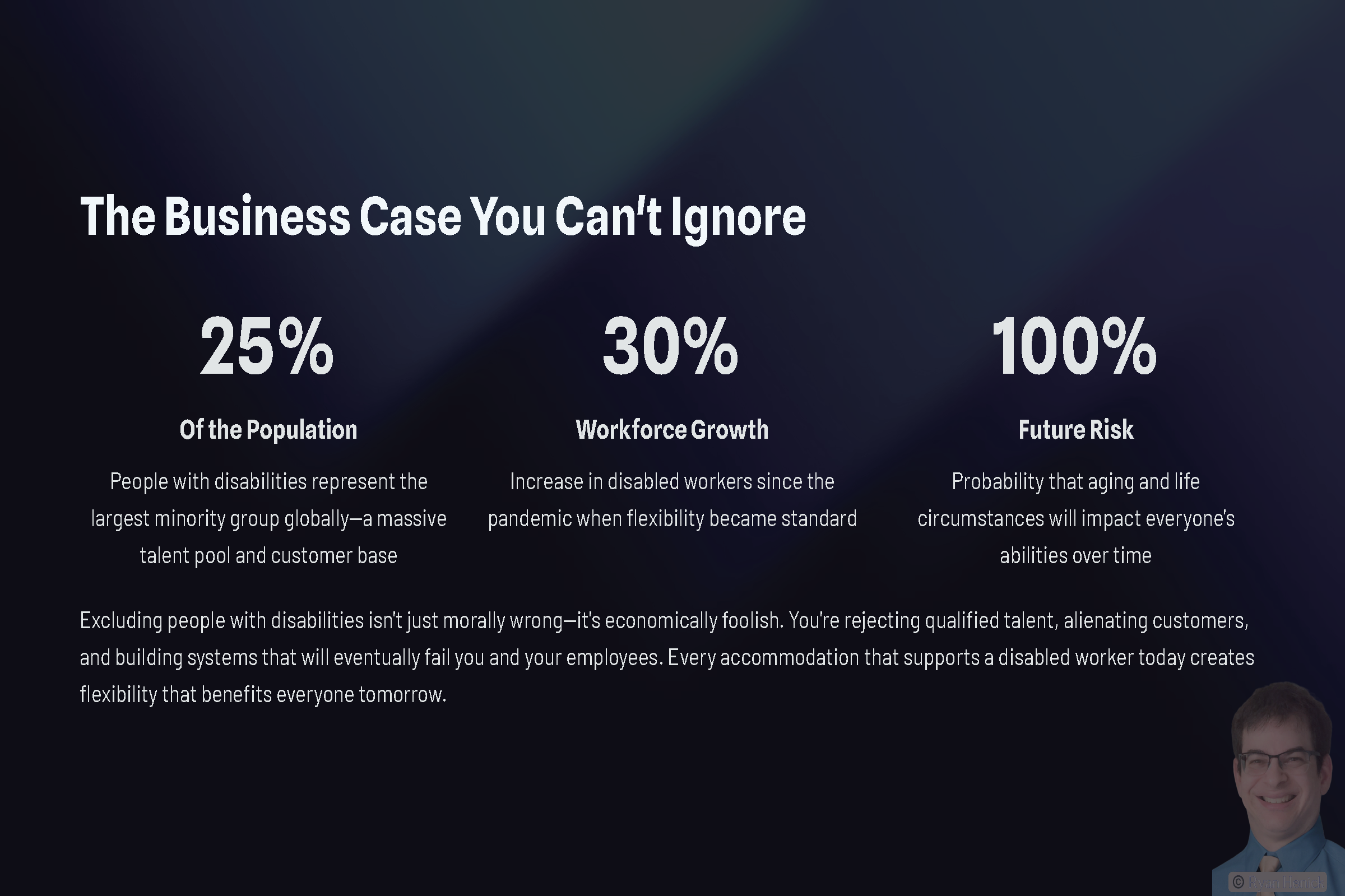
Slide titled ‘The Business Case You Can’t Ignore’ showing three statistics on disability inclusion: 25% of the population are people with disabilities, 30% workforce growth among disabled workers since the pandemic, and 100% future risk that aging or life circumstances will affect everyone’s abilities.

Inclusion isn't optional. Shocking I know.

We make up 25% of the population. We’re the largest minority in the world, and yet, every time a company “forgets” to plan for us, it’s not an oversight. It’s a decision. It’s saying: we don’t care to include a quarter of humanity.

And if you live long enough, disability will find you.

I joke sometimes that it’s like a mafia threat. “it’s coming for you.” But it’s true. We are all just temporarily pre-disabled. So when organizations treat inclusion like an experiment instead of a responsibility, what they’re really doing is gambling against their own future selves and interests.

That’s what makes the latest headlines so maddening.

Shaun Heasley, writing for Disability Scoop cites a report from SHRM noting workforce participation for people with disabilities is up 30% since the pandemic. Wendi Safstrom, president of the SHRM Foundation, calling it “a testament to what’s possible when organizations commit to inclusion and flexibility.”

She’s right. Remote work gave us the ability to get things done without burning half our energy fighting the world just to show up.

And somehow, in the same breath, SHRM handed the microphone to Robby Starbuck, a man who calls DEI “poison” and takes credit for dismantling inclusion programs at major corporations including Ford Motor Company, Harley-Davidson Motor Company, and Walmart. [H/t caroline colvin per HR Dive.]

Platforming that isn’t “viewpoint diversity.” Inclusion is not a debate topic any more than hiring women or people of color is a debate topic.

Every time an organization gives oxygen to anti-DEI voices, it tells us that our humanity is optional. And shame on any HR association that claims leadership while legitimizing that message.

Meanwhile, POLITICO reports that a federal judge had to order the White House to restore sign-language interpreters at press briefings, writing that “closed captioning and transcripts are insufficient alternatives.”

Because inclusion is optional, right?

Here’s the truth: every accommodation I’ve ever received has saved my career. I’ve spent my whole life negotiating with a body that doesn’t always cooperate. You think I can’t negotiate a work deadline? Please. I’ve been running logistics with chronic pain as a project manager my entire life.

To every HR leader who still calls inclusion a “buzzword,” you’re outing yourself as short-sighted. Inclusion isn’t charity. It’s how you tell your people they matter. It’s how you make the space you occupy, and ultimately leave on this planet better than you found it.

If your company’s culture falls apart the instant nobody's looking, or your accessibility policies look good on paper but collapse in practice, if your leaders talk about inclusion but can’t describe it without pausing to find the right words, we see you. You aren’t fooling us.

Do the right thing. Being a good human has only upsides.

When the Playground Becomes the Boardroom: How Bullying Grows Up

I read this story about a third grader in New Jersey. Teacher filmed her without consent. Passed the video around to make fun of her learning disability. A grown adult did that.

I felt sick.

We love to say bullying builds character. It doesn’t. It builds fear. It builds silence. It builds the habit of making yourself smaller so other people don’t have to feel uncomfortable.

The same lie we hand kids shows up at work. We call it "Culture.” “Fit.” “Professionalism.”

If nobody calls it out early, the people who mock you grow up thinking it’s leadership.

I asked a professor once for an accommodation. He asked how my “disease” was doing. Out loud. In front of thirty classmates. Cerebral palsy isn’t a disease. I still remember every second of that silence.

Now I’m an adult and people still film me with my Canine Companions® Lovey. They don’t ask. They snap a photo or record, smile, and walk away.

Once it’s online, I lose control. That’s the part nobody thinks about.

The story hit me because it’s all connected.

We’re told to be calm when our rights are debated. Smile through it. Stay professional. Because if we get angry, we’re “too emotional.” If we stay quiet, we’re “not assertive enough.”

We don’t need more awareness months. We need decency.

Teach kids empathy now, and maybe one day the workplace won’t look so much like the classroom.

NDEAM Is Over, but the Access Horror Show Runs Year-Round

An open spellbook glows with swirling blue magic that forms accessibility symbols, including a wheelchair icon and braille dots. The book rests on a wooden table surrounded by candles, pumpkins, and old scrolls, blending Halloween imagery with a sense of inclusive design and possibility.

They put a spell on you. Now that the calendar has flipped, do you care?

NDEAM is over, but the access horror show runs year-round.

The barriers are still right where we left them.

Feels about right, doesn’t it?

I spent the last day of NDEAM, which also happened to be Halloween, recording an episode of DisabilityEmpowermentNow with Keith Russell Murfee-DeConcini.

Keith asked thoughtful, generous questions, and we went there into the messy, human stuff. I call myself a Disability Advocate, Speaker, and Professional Persuader because most days are a negotiation between what is and what should be.

As I'm fond of saying: I’m not fighting because I enjoy the fight. I’m fighting so I can stop fighting.

As an advocate, my goal is to put myself out of business.

Since it was Halloween, we talked about masks and the stories we’re asked to wear. Every time we advocate for accessibility, I think about who decided what “normal” was in the first place. If normal is a choice, we can make a better one. One that doesn’t rank disabilities by visibility. One that assumes talent shows up in every kind of body and brain.

Now that NDEAM has wrapped, here’s the quiet part said out loud. It’s not enough to hire disabled people. We need to be in every room, at every level, shaping how access actually works. Accountability matters. Policies need enforcement and equity to move beyond optics.

Access is a 24/7 responsibility.

Episode release date coming soon. Follow Disability Empowerment Now and Keith to catch it when it drops.

CAMA 2025: What I Shared, What I Felt, and What We All Need to Hear

Ryan Honick smiles beside his golden service dog, Lovey, who wears a blue Canine Companions vest. Conference branding and professional credentials appear beside them.

This morning, I had the joy of presenting at the 5th Annual Communication Always Matters Always (CAMA) Conference—and I’m still catching my breath from the energy in the (virtual) room.

Thank you to Alisha Magilei-Noterman, Lisa Sandoval, and the Dynamic Therapy Solutions team for the honor of speaking alongside such passionate, intentional leaders. Being invited to this community means the world—and being able to share my lived experience with a service dog by my side, once again, feels both deeply familiar and wildly new.

Canine Companions® Lovey and I have only been home for a week since our team training in Medford—but she’s already making waves. This is her legacy in motion. And it’s only just begun.

In the weeks leading up to my training, folks in my world were cheering me on—excited for this next chapter and all it represented. For many, it sounded like a much-deserved break—something akin to a working vacation. And in some ways, yes, it was a pause from my daily professional life. But what it really was? Two weeks of focused, intentional work—emotional, physical, and cognitive. The kind of work that builds trust, redefines access, and prepares two beings to move through a world that isn’t built with us in mind.


And when I returned, so many people offered kind words: “You’re so inspiring.”

I know the intent is kind. But here’s the thing: I’m not here to inspire you. I’m here to inform you.

Because inclusion isn’t admiration. It’s anticipation. It’s not “we installed the door button”—it’s “does the button work, and is anyone checking?” Inclusion is not a checklist. It’s culture. And culture is built in the micro-moments.

70% of disabilities are invisible. That means most access needs aren’t obvious—and yet still require support, flexibility, and understanding. Even as a wheelchair user with a service dog, I regularly advocate for the things you can’t see: fatigue, visual processing, coordination challenges, the need for breaks between back-to-back meetings to care for myself and my dog.

Inclusion must be proactive—not reactive. I didn’t start documenting my rideshare denials to become “the service dog guy.” I did it because it was the only way to get platforms to take accountability.

Lovey and I are continuing that legacy now—with presence, with persistence, and with joy.

And what hit me most today? That every single one of these stories—about team training, workplace access, invisible disability, and culture change—sparked real conversation. People asked questions. Shared reflections. Saw themselves in the stories.

That’s why I do this work. Not for applause, but for the dialogue that follows. For the shift it creates. And for the people who leave a little more ready to advocate—for themselves or someone else.

Change happens one conversation at a time.

If you're a leader: model inclusion.
If you're a coworker: ask questions.
If you're disabled: keep going.

The Non-Sports Fan’s Survival Guide to Super Bowl LIX (Yes, You Can Fake It)

A photograph of a rugged, slightly worn "Survival Guide" handbook sitting on a living room coffee table cluttered with snacks, a remote control, and a half-empty soda can. The title "Survival Guide" is embossed in bold, comic-style block letters on the cover, with a distressed yet humorous aesthetic. The background features a blurred TV screen showing a football game.

It’s that time again—when nacho consumption soars, brands spend millions to make us cry over a talking golden retriever, and for one night, everyone suddenly becomes an expert on “momentum shifts.”

But what if you, dear reader, couldn’t care less about National Football League (NFL) Super Bowl LIX? What if you'd rather be anywhere else but trapped in a four-hour football marathon?

Good news! My annual guide will help you fake it, escape it, or—dare we say—actually enjoy it (without suddenly developing “strong opinions” about pass interference).

Step 1: Know Just Enough to Survive

The Game: Kansas City Chiefs vs. Philadelphia Eagles. Yes, again. Just say, “This rematch really adds an extra layer of narrative intrigue.” People will nod.

The Halftime Show: Kendrick Lamar featuring SZA. Expect one spectacular performance and at least one person loudly declaring that nothing will ever top Prince in the rain.

The Commercials: The only time people shush each other to watch an ad for Doritos chips. Be on the lookout for confirmed spots from Kawasaki Motors Corp., U.S.A., Starbucks, Best Buy, Dove, GoDaddy, and of course, hims & hers.

Step 2: Your Three Foolproof Phrases

These timeless lines work every single year:

1️⃣ “I just hope it’s a good game.” (Safe, neutral, cannot fail.)
2️⃣ “That’s a bold call. Let’s see if it pays off.” (Say this during any big play, and you’ll sound like an analyst.)
3️⃣ “I’m really just here for the commercials.” (Truth.)

Step 3: Accessibility = Super Bowl MVP

Want to sound insightful and support inclusivity? Drop these into conversation:

“Glad they have ASL interpreters again this year!”

Super Bowl LIX will feature ASL performers for the anthem & halftime show. Shoutout to Matthew Maxey for making the music accessible!

“More events should have live descriptive audio.”

The game has real-time play-by-play for blind & low-vision viewers.

“Can we turn on captions?”

Accessibility helps everyone, especially during loud parties (or when your uncle won’t stop explaining the rules).

Step 4: Your Escape Plan

If the game drags on, try these classic moves:

The Kitchen Gambit: “I’ll check on the snacks.” (Never return.) Anheuser-Busch, Totino's, Häagen-Dazs Shops, Uber, Instacart, PepsiCo, and DoorDash all paid a fortune to influence you. Did it work?

The Bathroom Break of Unusual Length: No one will question 20+ mins of doomscrolling.

The Pet Excuse: “The dog looks anxious. I should sit with them.” (Even if they are sound asleep.)

Final Thoughts: Just Ride It Out

Look, the Super Bowl isn’t just a game—it’s a national event, an excuse for excessive dip consumption, and a night where even the most football-averse people must endure sports commentary.

But with these survival tips, you’ll make it through Super Bowl LIX unscathed.

Now, repeat after me:

“I just hope it’s a good game.”

Uber’s Service Dog Policy Update: Progress or Just PR?

Uber logo displayed on a modern, abstract background featuring curved shapes in black, blue, and mint green.

I’ve spent a lifetime advocating for disability rights, fighting for equity, and pushing companies to make accessibility a reality—I’ve seen firsthand how corporations talk a big game about inclusion but fail in practice. That’s why Uber’s recent policy update on service dogs caught my attention.

Uber has always been required by law to allow service dogs, yet enforcement has been inconsistent at best. While matched with Canine Companions® Pico, I documented hundreds of refusals on Twitter/X, confronted drivers, filed complaints—and all too often, the most Uber would do was ensure I wasn’t matched with that driver again. Consequences were minimal, and riders like me bore the burden of proving discrimination over and over again.

Now, Uber is rolling out a feature that allows riders to self-identify as service dog handlers. If a driver cancels after being notified, they receive a warning reminding them that refusal is illegal. “Any driver who violates this policy may permanently lose access to the platform,” says Uber’s Chris Yoon, as quoted in The Verge. That sounds good, right? Except I’ve been here before. The key word is 'may'. Will drivers actually be held accountable, or will this be another slap on the wrist?

Uber’s history gives me reason to doubt. The system still leaves room for discrimination. Drivers can cancel rides under false pretenses—claiming they couldn’t find the rider, going offline, or making other excuses to avoid accountability. I and many others have seen this playbook. Meanwhile, service dog handlers are forced to navigate awkward confrontations and potential ride denials just to get from Point A to Point B. It get's exhausting. No handler should be forced to leave their medical equipment at home to make it on time to their destination.

This new feature seems helpful, but it places even more responsibility on disabled riders to preemptively disclose our status, creating a record of our attempts to comply. But why should it be on us to reduce the risk of discrimination? Why aren’t drivers trained, vetted, and monitored more closely to prevent these issues in the first place?

To be clear, I want to believe this marks a real shift. Uber claims this feature was developed “in collaboration with leading advocacy organizations and service dog handlers.” Organizations including National Federation of the Blind, The Seeing Eye, and American Council of the Blind. That’s a step in the right direction. But my optimism is cautious. Until we see consistent enforcement—until drivers who break the law actually face removal—this is just another policy on paper, not a lived reality.

So I ask: What would true accountability look like to you? Have you faced service dog refusals in rideshare services? What changes would make a real impact?

Uber wants to make riding with a service animal easier

Why Lying About Disability Hurts Everyone

Silhouetted wheelchair user navigating through a bustling airport terminal during sunrise or sunset, with warm golden light streaming in from large windows ahead. The reflection of the light creates a glowing effect on the polished floor. Other travelers with luggage are blurred in the background, adding a sense of motion and activity to the scene.

Thanksgiving this year marked a bittersweet milestone for me: my first flight since the passing of my service dog, Canine Companions® Pico. Navigating air travel without his steadying presence was an emotional adjustment, but it also brought a new set of challenges to the forefront—ones I hadn’t anticipated as a wheelchair user.

Picture this: It’s the early hours of the morning, and I’m at DCA, waiting to board my flight to Seattle. Between navigating Transportation Security Administration (TSA) Pre-check, managing my luggage, and coordinating the safe onboarding of my wheelchair, I was already juggling more than most travelers might consider. And then came the questions.

The heightened interest in the mechanics of my Alber GmbH power-assist wheels meant fielding inquiries from airline staff who were understandably curious about the technology I rely on for mobility. Half-asleep and longing for coffee, I found myself explaining the specs of my chair like I was pitching a new gadget on Shark Tank ABC.

The lesson I learned? Preparation is survival. Much like I once traveled with paperwork to verify Pico’s working status, I now carry a one-page cheat sheet detailing everything about my wheelchair frame and wheels. It’s a necessity for safety reasons, and because of the pervasive scrutiny many disabled travelers face—scrutiny amplified by dishonest actions like those described in a recent viral story.

A passenger on a United Airlines flight tried to exploit early boarding by claiming he had a disability due to recent knee surgery. However, his actions unraveled when he requested a seat in the exit row, where passengers must confirm their ability to assist in emergencies—something Federal Aviation Administration regulations prohibit for people with certain disabilities. Faced with the choice of admitting he lied or forfeiting the coveted exit row seat, he indignantly claimed he was suddenly "fine" to sit there after all.

When individuals fake disabilities, it undermines the trust needed for systems like pre-boarding to work. Those of us with legitimate needs find ourselves subjected to greater scrutiny. Additionally, exploiting accommodations reinforces the false idea that they’re perks instead of rights—conveniences to be gamed rather than tools for equity. This attitude chips away at the dignity of those who rely on these systems. Disability is not a monolith, but one thing unites us: the barriers we face are real. Every "clever hack" or deception makes the rest of us pay a higher price, emotionally, physically, and logistically.

We, as a society, must do better. We must normalize empathy over suspicion and remember that accessibility isn’t just a checkbox on a corporate DEIA plan—it’s a commitment to dignity, inclusion, and equity for all.

Planning to lie about a disability to get early boarding? Read this

Rest Easy, Pico

A montage grid of photos featuring Ryan and Pico

Many of you know me for my advocacy work around disability rights, accessibility, and inclusion. Those who have followed my journey also know what an integral part of that advocacy my service dog, Canine Companions® Pico, has been. He was not just my companion but a key part of my mission to break down barriers and create a more inclusive world.

Last night, I had to say goodbye to my best friend, my partner, and my loyal service dog, Pico. Nearly 13 years of unwavering loyalty, love, and trust — Pico was more than a service dog. He made me a better human, a better advocate, and someone who could navigate the challenges of the world with confidence.

Waking up to the quiet today hits hard. It’s a silence I wasn’t ready for. Pico not only helped me navigate the world physically, but he also helped me grow as a person and reminded me every day of the power of loyalty, patience, and love.

Rest easy, Pico. You’ve earned your peace. Thank you for being the most amazing boy. I’ll carry your lessons and your love with me always.

Disability Pride: Beyond the Celebratory Facade

A wheelchair user wearing a superhero cape navigates a city street filled with obstacles like stairs and debris. The cityscape includes tall buildings, narrow doorways, and inaccessible paths.

Disability is like any other complex relationship, filled with highs and lows. Some days are easy, some days are challenging, and some days we triumph over societal barriers—lack of access, accommodations, empathy, or compassion. And then there are days when we’re simply too exhausted to fight and need time to recoup. We don’t owe anyone 24/7 optimism, even during Disability Pride Month, but that doesn’t mean our lives hold any less value.

My entrepreneurial father Craig Honick once told me, “Advocate so well you put yourself out of business.” It’s a lofty goal I still think about often. Ideally, we’d live in a world where disability awareness is ingrained in our societal fabric. But we’re not there yet. So, we fight. The progress we’ve made excites us, but the fight is exhausting, and we feel it deeply. As the calendar flips to a new month, we’ll still be here, fighting, and we’ll still be disabled.

Throughout this month, I and other advocates have spotlighted daily examples of our community’s struggle for basic equity and inclusion. But awareness without action is empty. Now that you’re aware of the struggles, what are you going to do? Too often, our voices are drowned out by our non-disabled peers. So here’s our ask: pass the mic when you can, amplify our stories, and when you see something wrong, speak up. We need your allyship not just in July, but all year long.

Emily Ladau put it best on the latest episode of The Accessible Stall podcast: “Sometimes I just don’t feel like practicing [Disability Pride]. I’m exhausted.” This sentiment resonates deeply. Pride in our disability is indeed an ongoing practice, a muscle that needs stretching. Awareness is step one. What will you do to be a better ally once the spotlight dims?

Here are some actionable steps to support disability advocacy and inclusion:

• Educate Yourself and Others: Learn about the issues facing the disability community and share this knowledge with those around you.

• Amplify Disabled Voices: Use your platform to highlight the stories and experiences of disabled individuals. Folks like Kristen Parisi, Tiffany A. Yu, MSc, Alexa Heinrich, Marisa Hamamoto, Margaux Joffe, CPACC, 🦻 Meryl Evans, CPACC (deaf), Keely Cat-Wells, Julie Harris, Jamie Shields, Catarina Rivera, MSEd, MPH, CPACC, Donna Cruz Jones, Sheri Byrne-Haber (disabled) and so many others who do amazing work.

• Advocate for Accessibility: Push for accessible practices in your workplace, community, and beyond. Accessibility benefits everyone.

• Offer Genuine Support: Ask disabled people what support looks like for them and follow through.

• Speak Up: When you see discrimination or inaccessibility, don’t stay silent. Use your voice to advocate for change.

Let’s move beyond just awareness. Let’s take action together to create a more inclusive and equitable world for all. Your allyship matters every day.