Access Matters

AI Is Changing the Future of Work. Disabled Workers Already Know What That Feels Like.

A large robotic hand lifts a small human figure in a suit by the back of his jacket and drops him toward a wire wastebasket filled with crumpled paper. The background is a flat bright blue.

Everywhere I look, people seem afraid of becoming irrelevant thanks to AI.

Disabled people know that feeling better than anyone. We've lived in that tension our entire lives. Alice Wong called us the oracles. She was right. We learned to read the world differently because the world was never built with us in mind.

AI can close the gap or blow it wide open. I see signs of both already.

On one hand, technology has always been the thing that lets me move through a world that was not designed for my body or my needs. Uber, Instacart, Amazon, remote work, every one of these tools expanded my independence. AI has joined that list. It sharpens my thinking, helps me get unstuck, and pushes me to see ideas from angles I might have missed. It never replaces my judgment, but it challenges me in a way that feels useful.

While the tools have improved, the system around them has not. Disabled unemployment is at 8.7%, still nearly twice the national average according to the latest jobs report from the Bureau of Labor Statistics. That's partially due to AI-driven hiring systems screening out candidates before a human ever sees a résumé. Systems built on training data that rarely includes disabled people. They are shaped by teams who often do not understand disability, workplace bias, or accessibility in practice. When the ground shifts, we tend to be the first ones hit.

I want people to understand that AI is neither miracle nor menace. It is a force multiplier amplifying whatever framework you build around it. If the framework is inequity, then inequity scales. If the framework is access, then access grows.

The real danger is creating the future of work without the people who need these tools the most.

What are you noticing in the workplace as AI becomes part of your workflow?

What Real Leaders Understand About Power And Trust

A black-and-white photo of a man in a suit pointing directly toward the camera, mid-sentence, conveying authority or confrontation.

When I hear a CEO say “get on board or quit,” my brain freezes.

I sit there for a minute, stunned that this even needs to be said.

What that really means is: Don’t question us. Don’t need anything. Don’t exist differently.

We’ve reached a point in workplace culture where control is being sold as leadership.

That’s not strength. It certainly isn't leadership.

As Sarah E. Needleman K. and Julia Hornstein recently wrote in Business Insider, the new mantra from companies like Palantir Technologies, GitHub, AT&T, Shopify and Coinbase is clear:

Embrace the company’s politics, its AI, its in-office mandate—or leave.

That’s control disguised as “efficiency.”

Let’s pause on that for a second, because this has nothing to do with work style and everything to do with power.

A real leader asks, how do I bring more people in?
A fearful one asks, how do I push people out?

Disabled employees—including me—are told to “prove” we can do the jobs we’ve already been hired to do.

We get accommodations approved one year, then re-fought the next because a new manager wants to “tighten culture.”

Meanwhile, as Kandiss Edwards at Black Enterprise Magazine noted, even showing up has a price tag now, about $55 a day for workers asked to return to the office.

That control? Someone’s paying for it.

Here’s the thing.

If you don’t trust your employees, look in the mirror and ask why.

Trust isn’t a perk.
It’s infrastructure.
It’s how access works.
Access isn’t extra. It’s how we exist.

If you’re leading with surveillance instead of support, you’re not leading.

The upfront cost? Turnover. Morale. But nothing gets tarnished faster than reputation and legacy. Something that takes decades to build and mere minutes to destroy.

At some point, people remember how you made them feel.
They remember if you led through fear or through trust.

So before you demand loyalty, ask yourself this:

What kind of culture are you loyal to?
And what does that loyalty cost the people you lead?

What My Service Dog Lovey Taught Me in Our First 90 Days as a Team

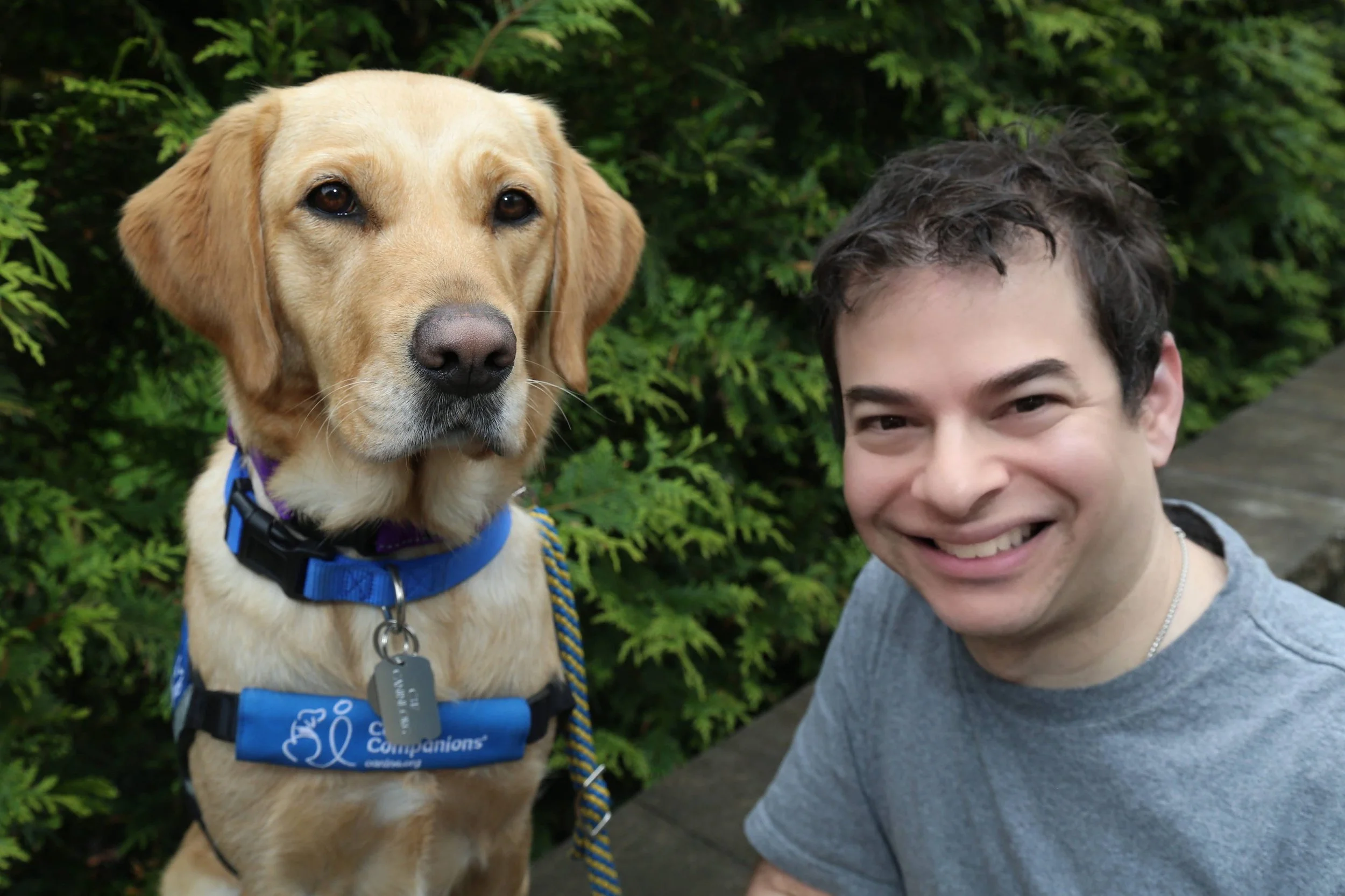
Ryan Honick smiles beside his service dog Lovey, a yellow Lab in a blue Canine Companions vest, with green foliage in the background.

Three months in, and I still catch myself smiling at the little things.

Canine Companions® Lovey bringing me socks I didn’t ask for. Trotting proudly with the leash in her mouth like she’s the one taking me for a walk. That perfectly timed automator button press when my hands are full.

We may have only just started, but the rhythm? It’s real.

The truth is, I didn’t know what this next chapter would feel like. New dog. New bond. New routine. But from day one, Lovey made it clear: she was ready. And I had to catch up.

Hardworking. Hilarious. The kind of dog who brings me clean socks—unprompted—like she’s running her own little Target. She followed me into the bathroom the first night like it was her job (spoiler: it kind of is). And one evening when I collapsed on the dorm floor in sheer exhaustion, she pounced on me like a 50-pound reminder that rest is okay—and also apparently playtime.

That’s when I started to feel it. Not all at once. But slowly. One command at a time. One tail wag. One moment of “Oh—you get me.” And she did. She does.

Graduation was a blur. I didn’t get handed Lovey’s leash by her puppy raiser—but their close friend passed it to me with the same intention: “She’s yours now.” And I felt that weight. That privilege. That joy. Because being matched with a service dog isn’t just about tasks. It’s about agency. It’s about trust.

And Canine Companions doesn’t just train dogs—they build partnerships. They saw something in me worth investing in. Again. Ten years after they first matched me with Pico, they did it all over—with the same care and commitment. All at no cost.

I take that seriously. Because Lovey isn’t a mascot. She’s not an emotional support animal or a pet in a vest. She’s trained. She’s focused. She’s the reason I can show up to policy briefings, comedy clubs, and day-to-day life without apology.

We’ve already changed how people interact with me in the world. Now, together, we’re going to change that world.

To the volunteers, trainers, puppy raisers, staff, and donors at Canine Companions—thank you. For trusting this match. For sharing our story. For ensuring that disabled people like me don’t just get access—we get partnership.

And to anyone wondering how to help? Support organizations like this. Elevate their work. Ask better questions. Fund the future.

Because when we say “service dogs change lives,” we mean it. I live it.

If you’ve worked with a service dog, what did they teach you?