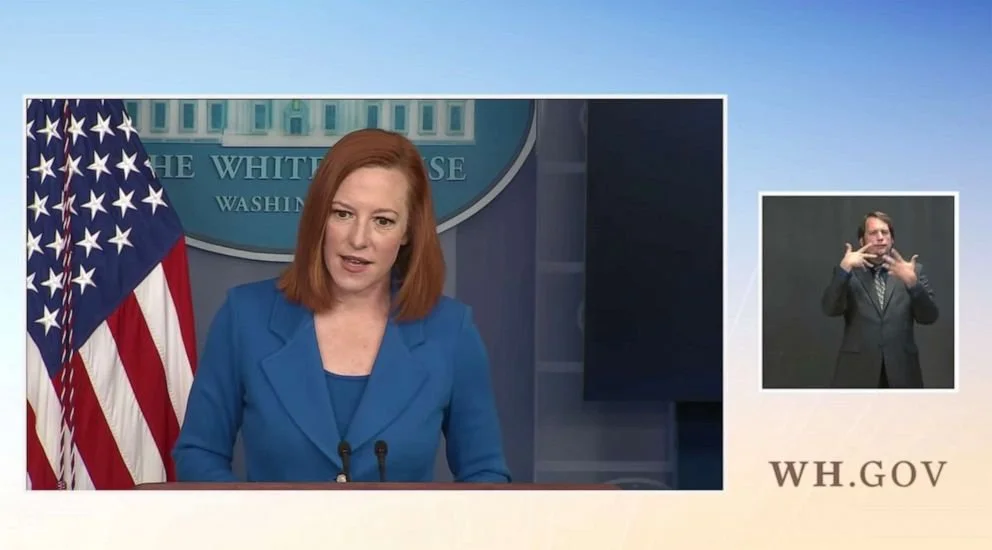
An American Sign Language interpreter provides interpretation during a White House press briefing, April 2021.
A disabled woman goes into Victoria’s Secret & Co. to try on clothes, and the accessible fitting room is full of junk.
To borrow a Biden-ism: Not a joke, folks.
Staff tells her it’ll be about 20 minutes while they clear it out, and before that, they tell her the regular rooms are “big enough” and make her try to fit her wheelchair in anyway. She later says the quiet part out loud: “I felt like a spectacle and an annoyance.”
It’s not just fitting rooms, either.
USA TODAY's Zach Wichter reports In 2024, airlines transported nearly 900,000 wheelchairs and scooters—and 1.26% were reported damaged or destroyed. That’s 11,357 mobility devices. People hear “1.26%” and shrug. Disabled people hear: don’t roll the dice with your body.
Let’s talk about education.
Researchers at UCLA are warning that when federal enforcement for special education gets unstable, schools can neglect annual IEP reviews and kids fall behind with less recourse for parents.
“The one thing that the IDEA does is it allows parents to have due process,” Connie Kasari, told the Daily Bruin.
Speaking of politics, Deaf advocates are fighting for ASL interpretation at publicly announced briefings, because some people would rather argue about “image” than acknowledge access is the law. The Progressive Magazine notes the argument being made against ASL interpretation is basically: it messes with the vibe. As quoted, lawyers argued that requiring interpretation “would severely intrude on the President’s prerogative to control the image he presents to the public.” The court’s response? Excluding deaf people is a “clear and present harm.”
I keep pulling on the same thread reading all of these headlines today.
We have a legal, fundamental, human right to exist. Disabled people are 20% of the population. If that makes you uncomfortable, interrogate your ableism.
Access is a thousand small daily calculations. Where do I have the energy to pick my battles? Where do I fight? Where do I go, all right, what workaround can I make because I’m too tired? Because in addition to fighting for access, we’re still living regular lives with doctor’s appointments, body aches, aging, family, jobs, trauma, all of it. And layering access fights on top.
There are days—I shouldn’t say this out loud—where the advocacy battle is so exhausting that I don’t want to leave my house. Then I get stuck in the loop: If I stay home, is that surrender? If I push through, am I burning myself down to prove I deserve to exist?
So here’s the takeaway:
Stop treating accessibility like storage. Stop treating it like a “special request” that only becomes real when a disabled person shows up and forces you to see them.
Where in your workplace, your store, your systems are you quietly betting disabled people won’t show up? Where are you asking us to “make it work” so you don’t have to change?