Disabled And Proud

Accessibility Failures in 2026: The Hidden Cost of Making Disabled People “Make It Work”

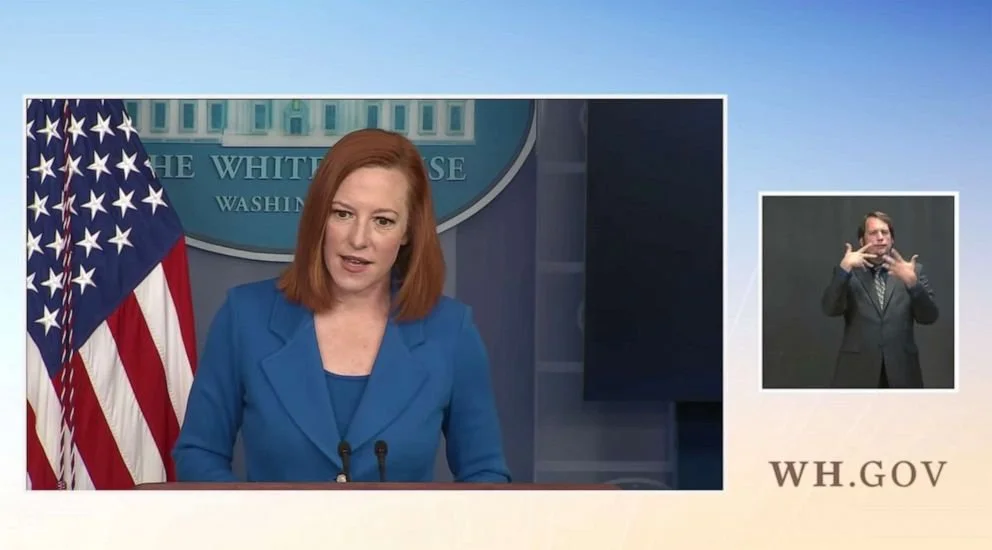
An American Sign Language interpreter provides interpretation during a White House press briefing, April 2021.

A disabled woman goes into Victoria’s Secret & Co. to try on clothes, and the accessible fitting room is full of junk.

To borrow a Biden-ism: Not a joke, folks.

Staff tells her it’ll be about 20 minutes while they clear it out, and before that, they tell her the regular rooms are “big enough” and make her try to fit her wheelchair in anyway. She later says the quiet part out loud: “I felt like a spectacle and an annoyance.”

It’s not just fitting rooms, either.

USA TODAY's Zach Wichter reports In 2024, airlines transported nearly 900,000 wheelchairs and scooters—and 1.26% were reported damaged or destroyed. That’s 11,357 mobility devices. People hear “1.26%” and shrug. Disabled people hear: don’t roll the dice with your body.

Let’s talk about education.

Researchers at UCLA are warning that when federal enforcement for special education gets unstable, schools can neglect annual IEP reviews and kids fall behind with less recourse for parents.

“The one thing that the IDEA does is it allows parents to have due process,” Connie Kasari, told the Daily Bruin.

Speaking of politics, Deaf advocates are fighting for ASL interpretation at publicly announced briefings, because some people would rather argue about “image” than acknowledge access is the law. The Progressive Magazine notes the argument being made against ASL interpretation is basically: it messes with the vibe. As quoted, lawyers argued that requiring interpretation “would severely intrude on the President’s prerogative to control the image he presents to the public.” The court’s response? Excluding deaf people is a “clear and present harm.”

I keep pulling on the same thread reading all of these headlines today.

We have a legal, fundamental, human right to exist. Disabled people are 20% of the population. If that makes you uncomfortable, interrogate your ableism.

Access is a thousand small daily calculations. Where do I have the energy to pick my battles? Where do I fight? Where do I go, all right, what workaround can I make because I’m too tired? Because in addition to fighting for access, we’re still living regular lives with doctor’s appointments, body aches, aging, family, jobs, trauma, all of it. And layering access fights on top.

There are days—I shouldn’t say this out loud—where the advocacy battle is so exhausting that I don’t want to leave my house. Then I get stuck in the loop: If I stay home, is that surrender? If I push through, am I burning myself down to prove I deserve to exist?

So here’s the takeaway:

Stop treating accessibility like storage. Stop treating it like a “special request” that only becomes real when a disabled person shows up and forces you to see them.

Where in your workplace, your store, your systems are you quietly betting disabled people won’t show up? Where are you asking us to “make it work” so you don’t have to change?

What It Really Means to Advocate for Disability Rights And Why I Keep Showing Up

Ryan and Canine Companions Lovey pose for a photo. Ryan is wearing a white shirt and jeans. He leans against Lovey who is staring straight ahead wearing her working vest.

I don’t always enjoy talking about myself, but when I do, I make sure it’s honest.

Grateful to be featured in the latest issue of WE ROAR Magazine™, where I got the chance to reflect on access, advocacy, and the quiet power of showing up (with Canine Companions® Lovey, of course).

Huge thanks to Kassandra Ayala-Najera, Jennifer Cairns and the entire WE ROAR team for the space to share my story—not just the polished wins, but the hard-won perspective that comes from navigating the world as a disabled advocate.

If you’ve ever wondered what keeps me in this work—or what it costs—this is a pretty good place to start.

Check out issue 10 here:

The Cost of Silence: How DEI Rollbacks Are Erasing Disability from the Conversation

Person tied to a ship’s mast in stormy seas, surrounded by flying papers, rough waves, and glowing lights on rocky shores—symbolizing focus amid chaos and distraction.

I’ve been thinking a lot about sirens. Not the ones on ambulances—the other kind. The ones Chris Hayes describes in The Sirens’ Call: mythic, seductive, dangerous. They don’t just scream for your attention—they lure it, sing to it, steal it. And they drag you straight into the rocks.

What happens when an entire government starts operating like that?

Over the past few weeks, the Trump administration has turned civil rights enforcement into political theater. Agencies like the EEOC and Federal Communications Commission are being used not to protect marginalized groups—but to punish them. DEI programs that once opened doors for Black and Brown students, queer workers, and yes, disabled professionals, are being framed as threats. The EEOC has launched investigations into university internships and law firm diversity programs. The FCC is probing The Walt Disney Company over inclusive storytelling. The OFCCP, once a watchdog for federal contractor discrimination, is being gutted from the inside. And while that’s happening, the president is casually floating the idea of a third term—telling NBC News, “There are methods.”

It’s not just authoritarian. It’s a masterclass in distraction. And in that swirl of headlines and spectacle, something deeply dangerous is happening: disabled people are disappearing from the narrative. Again.

We are not just being excluded. We are being erased. DEI policies that included disability are being dismantled. Federal workers with disabilities—many who’ve built careers serving their country—are being laid off or pushed out, quietly and en masse. States like New York and Wisconsin are scrambling to rehire them, but the national spotlight is elsewhere. The sirens are too loud.

Chris Hayes writes, “Attention is the substance of life… Every moment we are awake, we are paying attention to something.” That means what we don’t pay attention to? It can be just as powerful. Just as dangerous. I’ll be honest—this isn’t theoretical for me. I’ve been in the rooms where disability was a box no one wanted to check. Where accessibility was always someone else’s job. Where inclusion didn’t extend to people like me. And now those gaps have become openings for erasure, policy by policy, silence by silence.

We’re watching a full-scale rollback of civil rights—framed as “equity” for those who already hold power—and it’s working because we’re not paying attention to who’s falling through the cracks. Especially disabled folks. Especially those at the intersection of race, gender, and disability.

So here’s my ask: Pay attention. Look past the spectacle. Follow the stories that aren’t being told. Because attention isn’t just a resource. It’s a form of protection. And when we withhold it, people get hurt.

The sirens are singing louder every day. Some of us are still tied to the mast. Don’t look away.