
Yesterday I joined CBS News to talk about a new Lyft settlement after Tori Andres was repeatedly denied rides because of her service dog, Alfred.
If I ever get the chance to meet her, the first thing I’d say is thank you.
Speaking up about discrimination takes courage, and it helps highlight a pattern that service dog teams have been documenting for years.
Service dogs like Alfred and Canine Companions® Lovey are our medical equipment with a heartbeat and our access partners in a world still too often built without us in mind.
Accountability like this is how change starts.
Thank you to Jennifer Williams and the entire CBS team for amplifying disabled voices and helping move the conversation toward real access and equity.
Accessibility Failures in 2026: The Hidden Cost of Making Disabled People “Make It Work”
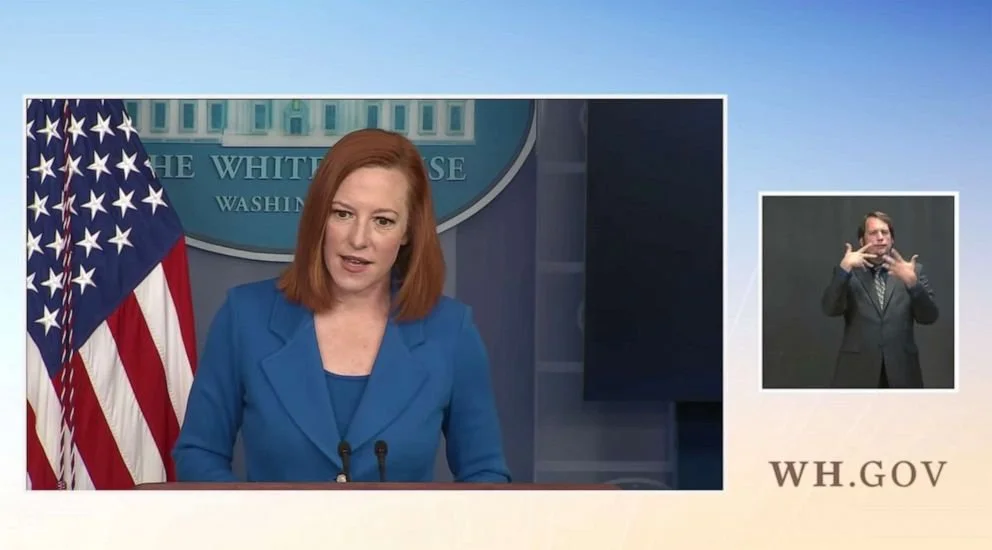
An American Sign Language interpreter provides interpretation during a White House press briefing, April 2021.
A disabled woman goes into Victoria’s Secret & Co. to try on clothes, and the accessible fitting room is full of junk.
To borrow a Biden-ism: Not a joke, folks.
Staff tells her it’ll be about 20 minutes while they clear it out, and before that, they tell her the regular rooms are “big enough” and make her try to fit her wheelchair in anyway. She later says the quiet part out loud: “I felt like a spectacle and an annoyance.”
It’s not just fitting rooms, either.
USA TODAY's Zach Wichter reports In 2024, airlines transported nearly 900,000 wheelchairs and scooters—and 1.26% were reported damaged or destroyed. That’s 11,357 mobility devices. People hear “1.26%” and shrug. Disabled people hear: don’t roll the dice with your body.
Let’s talk about education.
Researchers at UCLA are warning that when federal enforcement for special education gets unstable, schools can neglect annual IEP reviews and kids fall behind with less recourse for parents.
“The one thing that the IDEA does is it allows parents to have due process,” Connie Kasari, told the Daily Bruin.
Speaking of politics, Deaf advocates are fighting for ASL interpretation at publicly announced briefings, because some people would rather argue about “image” than acknowledge access is the law. The Progressive Magazine notes the argument being made against ASL interpretation is basically: it messes with the vibe. As quoted, lawyers argued that requiring interpretation “would severely intrude on the President’s prerogative to control the image he presents to the public.” The court’s response? Excluding deaf people is a “clear and present harm.”
I keep pulling on the same thread reading all of these headlines today.
We have a legal, fundamental, human right to exist. Disabled people are 20% of the population. If that makes you uncomfortable, interrogate your ableism.
Access is a thousand small daily calculations. Where do I have the energy to pick my battles? Where do I fight? Where do I go, all right, what workaround can I make because I’m too tired? Because in addition to fighting for access, we’re still living regular lives with doctor’s appointments, body aches, aging, family, jobs, trauma, all of it. And layering access fights on top.
There are days—I shouldn’t say this out loud—where the advocacy battle is so exhausting that I don’t want to leave my house. Then I get stuck in the loop: If I stay home, is that surrender? If I push through, am I burning myself down to prove I deserve to exist?
So here’s the takeaway:
Stop treating accessibility like storage. Stop treating it like a “special request” that only becomes real when a disabled person shows up and forces you to see them.
Where in your workplace, your store, your systems are you quietly betting disabled people won’t show up? Where are you asking us to “make it work” so you don’t have to change?
Real Access Starts With Trust: Why Disabled Workers Are Burning Out
Every October, the same playbook rolls out.
National Disability Employment Awareness Month. NDEAM. That one time a year when agencies and companies race to post glossy graphics and say all the right things about valuing disabled talent.
Here’s the thing: we don’t need a marketing campaign. We need a functioning workplace.
Because while the federal government brands itself as a “model employer,” the reality for many of us doesn’t match the message. Too often, the accommodations process feels less like a conversation and more like a slow-motion extraction.
When things go right, it’s simple. An employee says, “I need this,” and you work together to figure it out. That’s what a healthy workplace looks like. But when leadership wants the optics without the action, the process turns adversarial.
Paperwork is requested. Then more paperwork. Then silence. Then suddenly your performance is under review. Not because anything changed, but because you disclosed. Because you asked for what you need to succeed.
That’s not a problem employee. That’s a problem environment.
And the delays? They do real harm. Earlier this year, a federal court ruling found that a six-month delay in approving a service dog for a public employee may have violated the ADA. The court didn’t just critique the decision. It flagged the delay itself as discriminatory.
People are being worn down by design.
Across the federal workforce, we’re seeing a quiet purge. According to The New Yorker more than 550 disability-related complaints were abandoned after the U.S. Department of Homeland Security dismantled its civil rights office. Agencies are walking back hybrid work and delaying accommodations that used to be routine. Even the EEOC, the agency that enforces disability rights, has seen its own disabled staff pushed to fight for access.
This is not accidental.
When a disabled employee asks for an accommodation, they are not asking for special treatment. They are saying, “I want to keep doing the job you hired me to do.”
But too often, that disclosure is weaponized. Suddenly we’re seen as less capable. Projects are reassigned. Promotions disappear. The same systems that talk about equity on their websites make us jump through hoops to be treated with dignity.
And the real kicker? Most accommodations cost under a hundred bucks to implement. What costs more is burnout. Turnover. Legal fees. And reputational damage.
So let’s talk about what real access looks like.
• It looks like believing people when they say what they need.
• It looks like cutting the red tape that delays support.
• It looks like holding toxic leadership accountable, not promoting them.
• It looks like building trust, not breaking it the moment someone discloses.
And it looks like this: If you're going to call yourself a model employer, act like it.
Access Isn’t Extra: What It’s Really Like Navigating Seattle with a Service Dog

Canine Companions Lovey holds a pair of socks in her mouth while staring directly into the camera.
New city, same fight.
Over Labor Day weekend, my girlfriend and I went to see a comedy show at The Crocodile Seattle. It was supposed to be a chill date night. Instead, the guy at the door gave us side-eye and told us:
“We don’t allow dogs.”
I told him: Lovey is a service dog.
He said: “Doesn’t matter.”
It did matter. Legally. Ethically. Logically.
We asked for the manager.
She got it instantly. She saw Lovey’s Canine Companions® vest, smiled, and walked us to our seats. But the same staffer who initially denied us entry? He made sure we knew we weren’t welcome, even after being corrected.
That look in his eye—the disdain for being told he was wrong—that’s going to live in my body for a while.
Here’s the thing:
I wasn’t asking for VIP treatment. I wasn’t trying to make a scene. I just wanted to enjoy a show with my partner and my trained, federally protected access partner by my side.
But access wasn’t given.
It had to be won. Again.
This past month, I’ve:
• Been denied indoor seating at restaurants
• Had packages repeatedly misdelivered because Amazon drivers ignore access notes
• Been told “I don’t think I can do that” after requesting a door opener at Starbucks
• And had groceries dropped off at the wrong building by an Instacart driver who refused to admit it—then told me to “contact support”
Each one of these things on their own might seem like no big deal.
But they’re not one-offs.
They’re the tax we pay for needing access.
They’re the emotional labor of having to fight—calmly, constantly—for the right to participate.
And even then, we’re expected to smile.
Not get too loud.
Not push too hard.
Because “everyone’s doing their best,” right?
Except we’re paying for services that don’t serve us.
We’re doing the work of fixing the broken systems we didn’t break.
My girlfriend, who’s lived in Seattle her whole life, looked at me after all of this and said:
“I feel embarrassed for my city.”
Let me say this clearly:
Access is dignity.
Access is a right.
Disabled people deserve to exist without making everything a fight.
And since it’s National Service Dog Month, let me also say: Lovey isn’t a pet. She’s not optional. She’s not “extra.” She’s a trained, working professional who helps me live. And her presence doesn’t make me inspirational. It makes me able to participate.
I’m not fighting because I enjoy the fight.
I’m fighting so I can stop fighting.