
Workplace Equity

Inclusion Only Works When You Mean It: The Numbers Behind Disability Employment

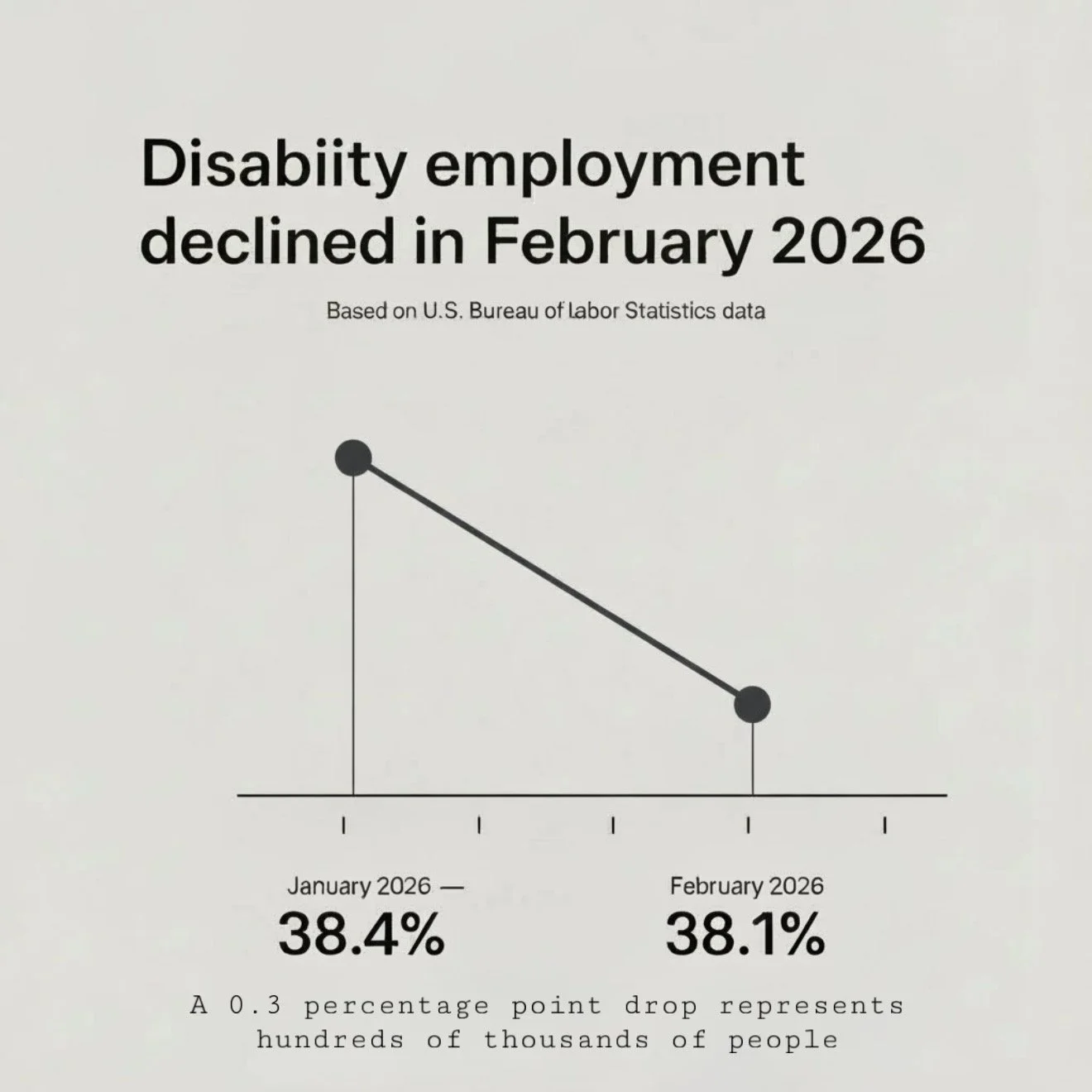
Line chart showing disability employment declining from 38.4% in January 2026 to 38.1% in February 2026, based on U.S. Bureau of Labor Statistics data, with note on a 0.3 percentage point drop.

Disability employment just dropped.

From 38.4% to 38.1% in one month.

That change represents hundreds of thousands of people losing ground in a single month, according to the latest nTIDE report from the Kessler Foundation based on data from the Bureau of Labor Statistics.

On paper, it looks small, just a fraction of a percentage point. In practice, it reflects movement in the wrong direction at the same time LinkedIn is full of companies talking about their commitment to inclusion.

For those of us who have been living in this space for a while, it feels predictable. This is what it looks like when inclusion is treated as messaging instead of something structural.

We get hired, and for a moment it looks like progress. Once we are inside the role, the reality starts to narrow. Job requirements that never quite made sense begin to matter, accommodations that were described as straightforward turn into drawn-out processes, and support that was implied becomes something that has to be justified repeatedly.

Over time, the system finds it easier to question us than to examine whether the environment was ever set up for success in the first place.

That is the part that does not show up in the celebration posts. It is also the part that explains the numbers. When people cannot get in, cannot stay, or cannot grow, the math does not hold.

Inclusion only works when you mean it. It does not work as a campaign or a metric. It works when leadership and infrastructure actually shift to support the people brought into the organization.

Right now, many organizations have not made that shift, and the data is reflecting that in real time. We feel it at every stage, when applications go unanswered, when more energy is spent fighting for access than doing the job itself, and when strong performance still leads nowhere.

We can continue to celebrate progress, but the numbers are telling a different story.

If inclusion begins to fall apart the moment it becomes inconvenient, what exactly are we building?
Creative, Inclusive Workspaces: What We Can All Learn from the Adaptive Umbrella Workshop

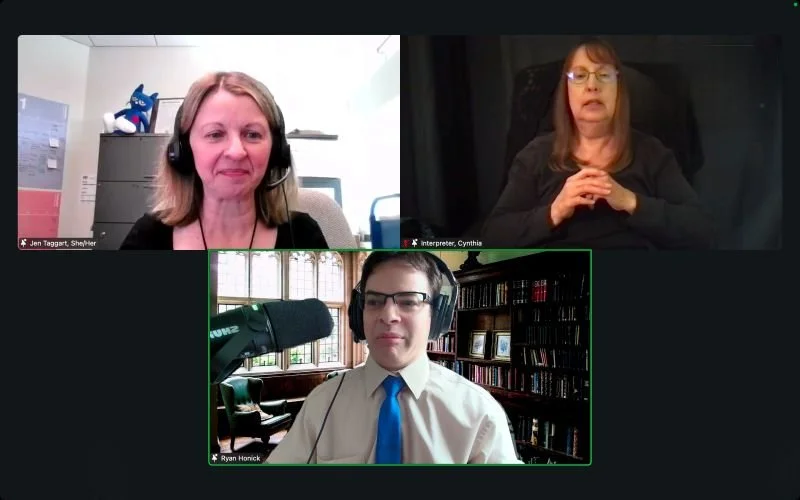
Ryan presents via Zoom at a workshop on creating inclusive workspaces.

As we kick off National Disability Employment Awareness Month, yesterday I had the incredible honor of delivering the closing keynote address at the Adaptive Umbrella Workshop, hosted by the Bloomfield Township Public Library. This workshop focused on fostering creative, inclusive workspaces, and it was a privilege to share my thoughts on how we can create environments where everyone feels like they belong.

I've seen firsthand how conversations around diversity, equity, inclusion, and access are often treated like checkboxes—something to do out of obligation rather than a genuine effort to celebrate difference. During the workshop, we talked about how true inclusion goes beyond merely checking off boxes; it’s about cultivating a culture where disability isn’t a dirty word or something to dance around.

We discussed how equity, not just equality, must be the goal. Equity recognizes that everyone needs different tools to succeed. The idea that reasonable accommodations—whether it’s telework, flexible schedules, or assistive technology—are “special” or “unfair” is still prevalent in many workplaces. But these accommodations are about creating a level playing field.

In the federal government, where I've worked for over a decade, telework has been a game-changer, especially during the pandemic. But it isn’t just about the pandemic—it’s about offering flexibility for employees who navigate complex physical and invisible disabilities like chronic pain. Accommodations like these are about empowerment, not favoritism.

Another important topic we tackled was the disclosure of invisible disabilities. A 2023 study by the SHRM revealed that 47% of employees with invisible disabilities haven’t disclosed them to their employers. This comes from a place of fear—fear that disclosure will harm career prospects or lead to workplace stigma. Employers must create safe spaces where employees feel empowered to disclose if they choose to, without fearing repercussions.

Finally, we talked about resentment. Sadly, workplace accommodations are often misunderstood, leading to friction among coworkers who don’t see or understand the need. But as I shared during my keynote: It’s not the manager’s job to justify accommodations to other employees. Accommodations are about equity.

This workshop reminded me that building inclusive workspaces is an ongoing process. It’s about continuous education, open conversations, and creative solutions. The more we talk about what inclusion really looks like, the better we get at building work environments that uplift everyone, not just a select few.

A huge thank you to Jennifer Taggart and the Bloomfield Township Public Library for hosting such an important event, and to everyone who attended and asked thought-provoking questions. Your engagement fuels the work we’re doing to create a more equitable future.