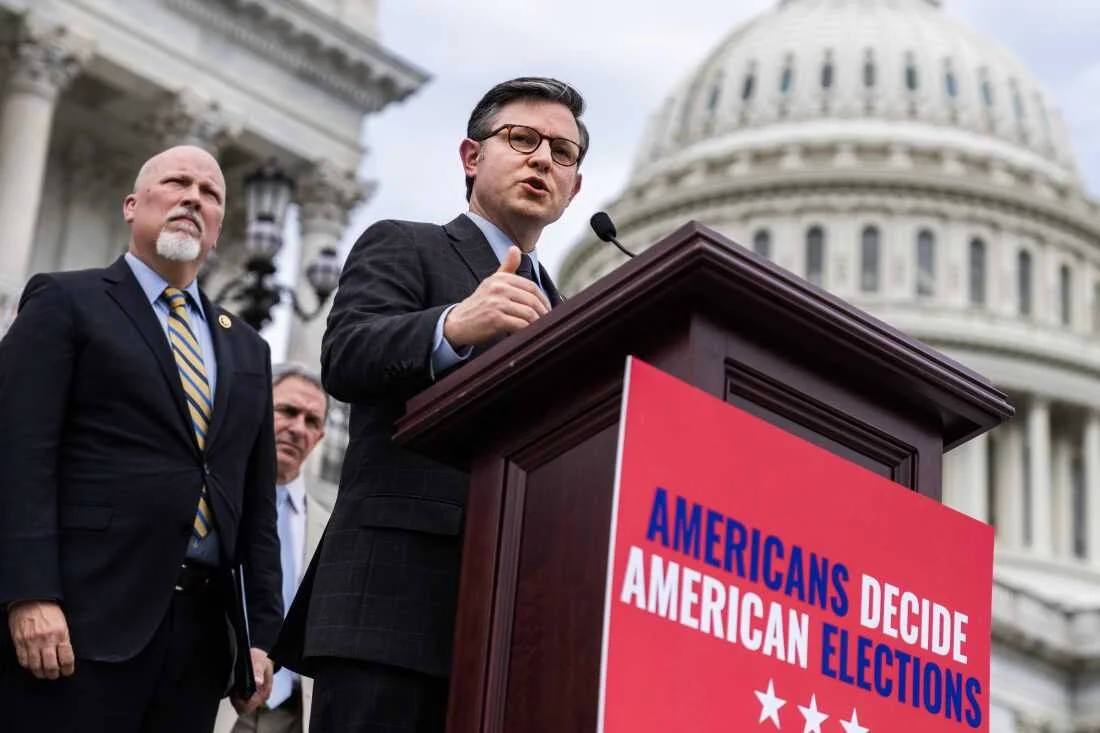
Speaker of the House Mike Johnson (R-La.), Rep. Chip Roy (R-Texas) (left), and Ken Cuccinelli (background), former attorney general of Virginia, hold a news conference on the House steps of the U.S. Capitol to introduce the "Safeguard American Voter Eligibility (SAVE) Act," which would mandate proof of U.S. citizenship for voter registration in federal elections, on Wednesday, May 8, 2024.
When we talk about access to voting, we tend to describe systems as “accessible” even when they depend on help to work.
That gap becomes a lot more visible when you look at the SAVE America Act, which would require documents like a birth certificate or passport just to register to vote.
For some people, that might sound like a reasonable safeguard.
But it only feels simple if you assume those documents are easy to access.
A recent TIME piece by Naomi Hess points out that disabled voters already face significant barriers when it comes to participating in elections, and adding more documentation requirements builds on top of those challenges rather than removing them.
At the same time, we are watching national negotiations stall while tying government funding to these same voting restrictions, which shows how central this issue has become in the broader conversation about participation.
I’ve spent most of my adult life voting by mail, not because it’s easier, but because the alternative didn’t work for me. The few times I tried to vote in person, the barriers weren’t subtle. They showed up in whether I could move through the space independently, whether the layout made sense, and whether the process assumed a level of mobility I didn’t have.
But even systems that are meant to improve access come with their own conditions. Before you ever get to a ballot, you have to prove who you are, and that process assumes access to documentation, time, and energy that not everyone has.
I know how to navigate those systems. I’m organized. I’ve done it before.
And even then, it takes effort.
That’s the part that tends to get flattened in policy conversations.
We often describe something as accessible when it can work with assistance, and that distinction matters more than people realize. I’ve lost count of how many times I’ve had to call ahead to a venue or a restaurant just to understand what “accessible” actually means in practice, and whether that access depends on someone being available to help.
Because once it does, the experience changes.
If access depends on someone else stepping in, it’s not really access. It becomes something you have to coordinate, request, and hope will be available when you need it.
When you apply that same logic to voting, the implications are hard to ignore. Every additional requirement does more than verify identity. It shapes who is realistically able to participate.
We say voting is a right, but the way we structure access to it tells a more complicated story.
So I keep coming back to this:
If the goal is participation, why are we building systems that make it harder to achieve?