Human Resources

Inclusion Isn't A Debate: Why SHRM Got It Wrong

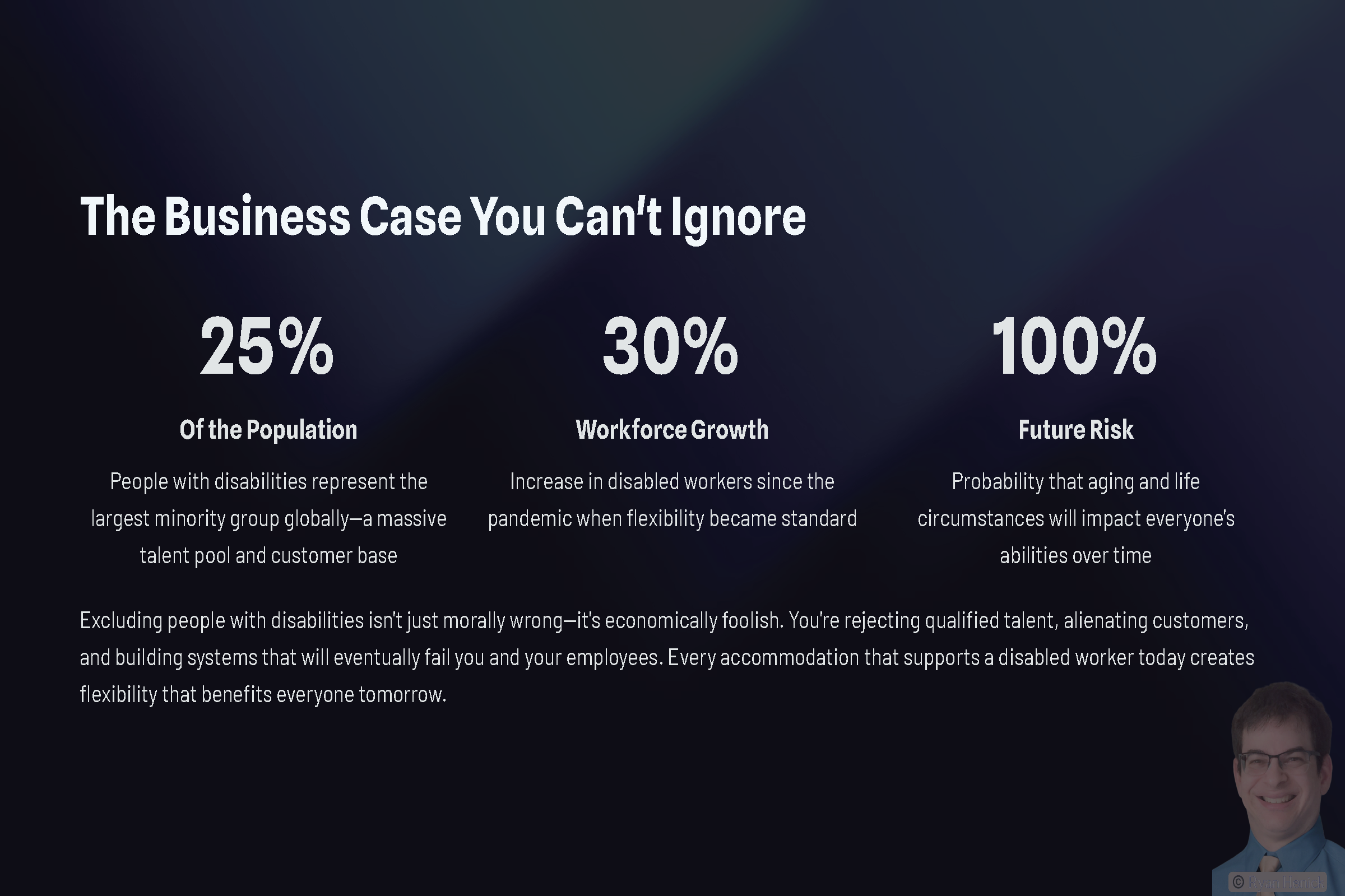
Slide titled ‘The Business Case You Can’t Ignore’ showing three statistics on disability inclusion: 25% of the population are people with disabilities, 30% workforce growth among disabled workers since the pandemic, and 100% future risk that aging or life circumstances will affect everyone’s abilities.

Inclusion isn't optional. Shocking I know.

We make up 25% of the population. We’re the largest minority in the world, and yet, every time a company “forgets” to plan for us, it’s not an oversight. It’s a decision. It’s saying: we don’t care to include a quarter of humanity.

And if you live long enough, disability will find you.

I joke sometimes that it’s like a mafia threat. “it’s coming for you.” But it’s true. We are all just temporarily pre-disabled. So when organizations treat inclusion like an experiment instead of a responsibility, what they’re really doing is gambling against their own future selves and interests.

That’s what makes the latest headlines so maddening.

Shaun Heasley, writing for Disability Scoop cites a report from SHRM noting workforce participation for people with disabilities is up 30% since the pandemic. Wendi Safstrom, president of the SHRM Foundation, calling it “a testament to what’s possible when organizations commit to inclusion and flexibility.”

She’s right. Remote work gave us the ability to get things done without burning half our energy fighting the world just to show up.

And somehow, in the same breath, SHRM handed the microphone to Robby Starbuck, a man who calls DEI “poison” and takes credit for dismantling inclusion programs at major corporations including Ford Motor Company, Harley-Davidson Motor Company, and Walmart. [H/t caroline colvin per HR Dive.]

Platforming that isn’t “viewpoint diversity.” Inclusion is not a debate topic any more than hiring women or people of color is a debate topic.

Every time an organization gives oxygen to anti-DEI voices, it tells us that our humanity is optional. And shame on any HR association that claims leadership while legitimizing that message.

Meanwhile, POLITICO reports that a federal judge had to order the White House to restore sign-language interpreters at press briefings, writing that “closed captioning and transcripts are insufficient alternatives.”

Because inclusion is optional, right?

Here’s the truth: every accommodation I’ve ever received has saved my career. I’ve spent my whole life negotiating with a body that doesn’t always cooperate. You think I can’t negotiate a work deadline? Please. I’ve been running logistics with chronic pain as a project manager my entire life.

To every HR leader who still calls inclusion a “buzzword,” you’re outing yourself as short-sighted. Inclusion isn’t charity. It’s how you tell your people they matter. It’s how you make the space you occupy, and ultimately leave on this planet better than you found it.

If your company’s culture falls apart the instant nobody's looking, or your accessibility policies look good on paper but collapse in practice, if your leaders talk about inclusion but can’t describe it without pausing to find the right words, we see you. You aren’t fooling us.

Do the right thing. Being a good human has only upsides.

The Hidden Biases of AI: What Disabled Job Seekers Need to Know

An individual stands in front of a large, illuminated 'AI' sign, surrounded by futuristic digital graphics and data displays, symbolizing the integration of artificial intelligence in modern technology.

Today, I’m diving into something that's been on my mind a lot lately: the role of artificial intelligence in hiring. AI has completely changed how we hire, making things quicker and more efficient than ever before. But as we jump on the AI bandwagon, we also need to talk about its potential downsides, especially when it comes to disabled candidates.

AI tools, like ChatGPT, have made hiring a lot smoother. They can zip through resumes, spotlight the good stuff, and flag any issues, making HR's job a lot easier. According to Bloomberg’s Sarah Green Carmichael, “Nearly half of recent hires used AI to apply for jobs, according to a survey by Resume Builder.” This is pretty huge, right? But let’s not kid ourselves—AI has its flaws.

A recent article by Gus Alexiou in Forbes highlighted an experiment by University of Washington researchers that found AI tools could be biased against resumes that mention disability. They compared a standard CV with six different versions, each highlighting different disability-related achievements. The results were pretty shocking: ChatGPT only ranked the disability-modified CVs higher than the control one 25% of the time. This means many qualified disabled candidates might be overlooked.

Commenting on the UW project, lead author Kate Glazko said, “Ranking resumes with AI is starting to proliferate, yet there’s not much research behind whether it’s safe and effective…. For a disabled job seeker, there’s always this question when you submit a resume of whether you should include disability credentials. I think disabled people consider that even when humans are the reviewers.” These types of biases often prevent disclosure of disability in the workplace, in all aspects—from being a candidate to an employee. Both humans and AI still have inherent biases that must be accounted for, and that starts with awareness and diverse perspectives in looking at the data.

This is where human oversight comes in. AI can help with hiring, but it shouldn’t replace human judgment. It’s like using a calculator—you need to understand the math first to know if the calculator’s answer is right. We still need humans to ensure that the AI’s decisions make sense. And even then, nothing is foolproof.

Survey data showed that many job seekers still needed to tweak their AI-generated content to avoid sounding like a robot, with 46% saying they edited the output “some” and only 1% not editing it at all. So, while AI is a handy tool, we can’t trust it blindly—whether you’re an applicant or a hiring manager.

As we move forward, we need to balance the speed and efficiency of AI with the essential human touch. Using AI as a tool rather than a replacement will help us create hiring practices that truly value the contributions of disabled candidates.

ChatGPT Is Biased Against Resumes Mentioning Disability, Research Shows