The Jobs AI Can’t Replace and the Workers It’s Already Erasing

3D rendered digital human head outlined with neon contour lines that resemble a fingerprint's unique swirls, against a deep blue background.

AI isn’t replacing workers. Policy is.

And when cuts come, disabled employees are too often first in line. Not because we can’t do the work. But because we asked for accommodations, or a flexible schedule. Or the audacity to be seen as fully human in a system that was never built for us.

Amazon laid off 14,000 corporate staff, most weren’t on the warehouse floor. As Fortune reports, they were middle managers, analysts, people whose work once held institutional memory. And while AI was the scapegoat, the real driver was a quiet shift in values: replace people with productivity.

Let me say it plainly: Every time efficiency comes at the cost of someone’s humanity, you lose.

Because here’s what AI will never replace:

• A colleague who notices and acts
• A mentor who listens without needing to understand everything
• The gut sense that something feels off—and the courage to say so
• A disabled employee who sees the policy gap before it creates harm

Try feeding that into OpenAI.

Accessible workplaces don’t happen by default. They’re built, sustained, and protected often by non-disabled colleagues whose advocacy carries more weight, simply because of the math. When the 80% speak up, momentum shifts. But the burden shouldn’t fall solely on disabled people. We’ve been saying the same things for years. Now we need others to help carry it forward.

I’ve watched colleagues pushed out for asking too many questions, for requesting an accommodation, or for simply challenging the status quo. And I’ve watched those same institutions spin it. “Moving in a different direction,” “transitioning,” “resigned to pursue other opportunities.” But those of us inside? We know how to read between the lines.

Gartner projects that 1 in 5 organizations will eliminate half their management layers using AI by 2026. That is a loss of human infrastructure, especially for marginalized communities who rely on advocates inside the system to challenge the status quo.

DEI isn’t a brand strategy. It’s a values system. And when it disappears, it erases people. And voices. And momentum.

“You can certainly change your branding, but you can’t change your values without it having a resounding effect,” former Georgia state representative and candidate for governor Stacey Abrams told The Washington Post.

So as AI reshapes our workplaces, let’s ask better questions.

What stories about work and value do we need to unlearn? Are we innovating for everyone, or just for the most efficient few?

Innovation that forgets its people isn’t progress. It’s loss.

AI may generate text. It will never generate trust.

Let’s keep the human at the center of the future we’re building.

Not All Disabled Leaders Are Allies, And That’s the Conversation We Need to Have

A man in a wheelchair sits in a doorway high on a dark glass skyscraper, kicking away a golden ladder as pieces fall toward a crowd of people reaching upward beneath stormy skies.

As October wraps up, I keep circling back to something we rarely say out loud: not all disabled people are allies.

John Oliver once joked on HBO Last Week Tonight about former Rep. Madison Cawthorn that “being an asshole is truly accessible to everyone.” He wasn’t wrong. We like to assume disabled leaders automatically champion the disability community, that lived experience guarantees empathy.

But it doesn’t.

Governor Greg Abbott, a wheelchair user, has consistently pushed policies that harm disabled Texans. Senator John Fetterman, once celebrated for normalizing assistive technology and comfortable clothing on the Senate floor, now carries the label “Trump’s favorite Democrat.” Representation does not always translate to advocacy. Sometimes it just makes the betrayal sting more.

And I have seen that same pattern play out closer to home. Early in my federal career, when I first needed a telework accommodation, I turned to a senior colleague who was a respected disability advocate. I expected empathy. Instead, he looked me straight in the eye and said, “Keep your head down. Don’t fight this.”

That moment never left me. It might have been practical advice, but it was not allyship.

It taught me that proximity to power is not the same as solidarity, and that some of the hardest lessons come from people who should have known better.

We love to talk about inclusion in the workplace. The posters. The hashtags. The polished commitments to mental health and belonging. But the moment someone actually uses those systems, asks for flexibility, PTO, or an accommodation, the tone shifts. Suddenly inclusion has an asterisk. Suddenly the same people preaching wellness start whispering about fairness and team morale.

Genuine allyship is not about the company newsletter or the press release in October or the panel during Disability Pride Month. It is about the quiet, consistent work of believing people when they tell you what they need, without making them prove it. It is about creating systems where asking for help does not feel like a liability.

There is a hierarchy in disability culture we do not talk about enough. The visible versus the invisible. The acceptable versus the difficult. The wheelchair user makes a great photo op. The employee with PTSD, chronic pain, or neurodivergence gets side-eyed for needing too much. Passing privilege is real, and too many use it to climb the ladder only to kick it down behind them.

Having a disability does not make someone an ally. It does not even make them kind. Sometimes it just makes them powerful enough to prove they are not.

If allyship means anything, it is how we act when no one is watching, especially toward each other.

Awareness Doesn’t Pay The Rent

A warmly lit café stage with a vintage microphone under a spotlight, brick wall backdrop, empty chairs, and a steaming mug in the foreground.

Every October, the feeds light up.
Wheelchairs in perfect lighting,
hashtags dressed for a party.

“Awareness.”

That word rolls too easy off the tongue.
But awareness doesn’t pay the rent.
It doesn’t rewrite policy.
It doesn’t get you promoted, either.

I’ve worked in communications long enough to know.
Awareness is the appetizer,
not the meal.
It’s the press release,
not the practice.
The promise without the paycheck.

You want courage?
Alright, here’s one.
Try staying in a workplace that calls your exhaustion “grit.”
Try using your leave,
and watching your reputation shift while you heal.
Try asking for equity,
and hearing silence so heavy
you could hang your coat on it.

We get hired for the photo,
not the promotion.
We’re celebrated when we show up,
forgotten when we speak up.
That’s not inclusion.
That’s PR with better lighting and a diversity hashtag on top.

For every disabled person you see,
there are three you don’t.
Chronic pain.
Neurodivergence.
PTSD.
Autoimmune conditions.
Invisible doesn’t mean imaginary.
It just means the world stopped looking.

One in four Americans lives with a disability.
That’s not a metaphor.
That’s the CDC talking.
Only four percent disclose.
That’s fear talking.
And fear—
fear’s got a corner office and a pension plan.

Here’s the truth.
I don’t want awareness anymore.
I want accountability.
I want leaders who ask what barriers to remove
before we hit them.
I want promotions that don’t come
with an asterisk
and a whisper.
I want policy written by the people who live it,
not by the ones who still think
“disability”
is a bad word.

Inclusion isn’t a month.
It’s not October’s costume.
It’s the budget.
It’s the boardroom.
It’s the elevator you send back down.

So when the hashtags fade
and the banners come down,
don’t just call me resilient.
Ask yourself why I had to be.

Because awareness is easy.
Action
Action is everything.

Real Access Starts With Trust: Why Disabled Workers Are Burning Out

Every October, the same playbook rolls out.

National Disability Employment Awareness Month. NDEAM. That one time a year when agencies and companies race to post glossy graphics and say all the right things about valuing disabled talent.

Here’s the thing: we don’t need a marketing campaign. We need a functioning workplace.

Because while the federal government brands itself as a “model employer,” the reality for many of us doesn’t match the message. Too often, the accommodations process feels less like a conversation and more like a slow-motion extraction.

When things go right, it’s simple. An employee says, “I need this,” and you work together to figure it out. That’s what a healthy workplace looks like. But when leadership wants the optics without the action, the process turns adversarial.

Paperwork is requested. Then more paperwork. Then silence. Then suddenly your performance is under review. Not because anything changed, but because you disclosed. Because you asked for what you need to succeed.

That’s not a problem employee. That’s a problem environment.

And the delays? They do real harm. Earlier this year, a federal court ruling found that a six-month delay in approving a service dog for a public employee may have violated the ADA. The court didn’t just critique the decision. It flagged the delay itself as discriminatory.

People are being worn down by design.

Across the federal workforce, we’re seeing a quiet purge. According to The New Yorker more than 550 disability-related complaints were abandoned after the U.S. Department of Homeland Security dismantled its civil rights office. Agencies are walking back hybrid work and delaying accommodations that used to be routine. Even the EEOC, the agency that enforces disability rights, has seen its own disabled staff pushed to fight for access.

This is not accidental.

When a disabled employee asks for an accommodation, they are not asking for special treatment. They are saying, “I want to keep doing the job you hired me to do.”

But too often, that disclosure is weaponized. Suddenly we’re seen as less capable. Projects are reassigned. Promotions disappear. The same systems that talk about equity on their websites make us jump through hoops to be treated with dignity.

And the real kicker? Most accommodations cost under a hundred bucks to implement. What costs more is burnout. Turnover. Legal fees. And reputational damage.

So let’s talk about what real access looks like.

• It looks like believing people when they say what they need.
• It looks like cutting the red tape that delays support.
• It looks like holding toxic leadership accountable, not promoting them.
• It looks like building trust, not breaking it the moment someone discloses.

And it looks like this: If you're going to call yourself a model employer, act like it.

What It Feels Like to Be Called 'Non-Essential' by Your Own Government

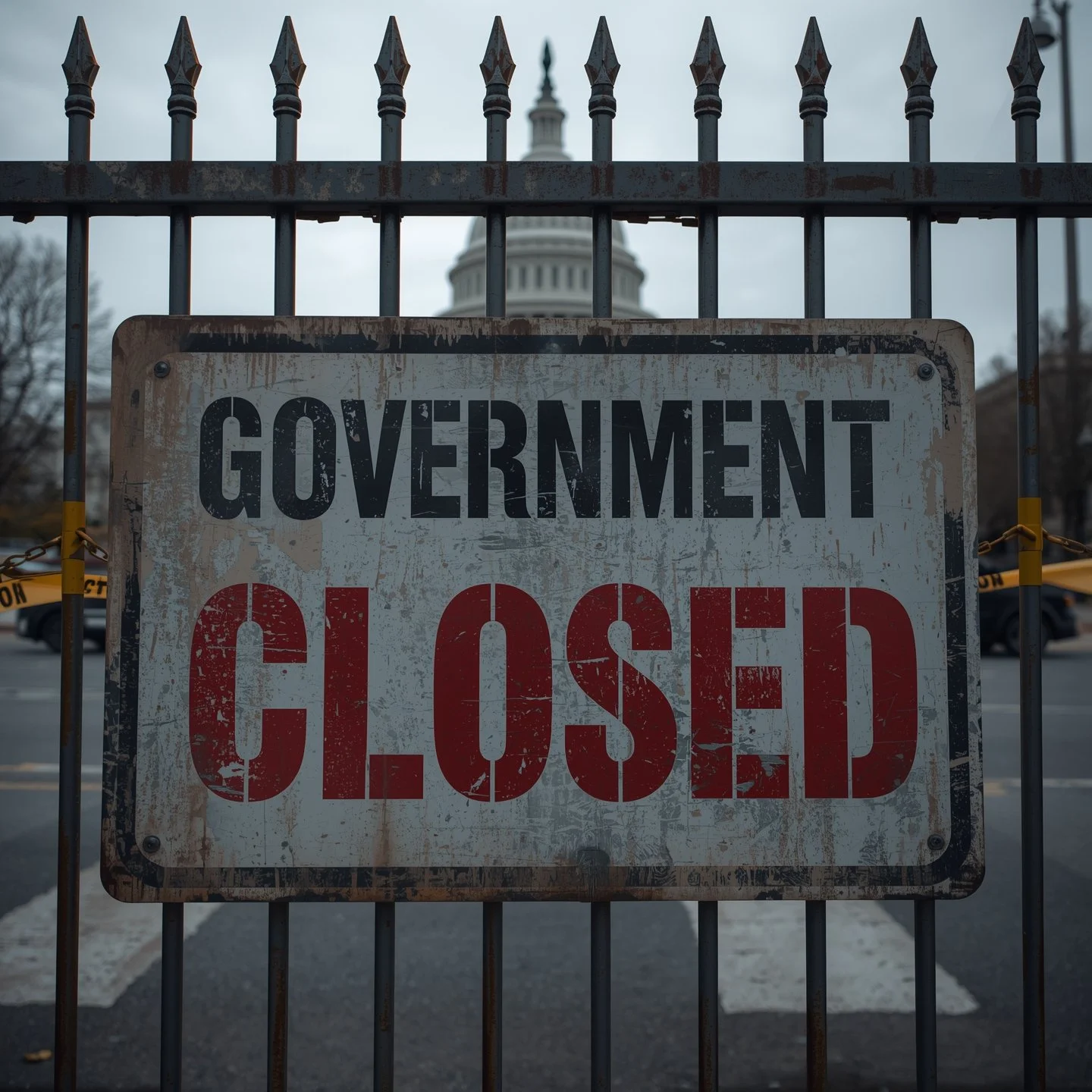
A weathered metal sign reading "Government Closed" is attached to a black iron fence, with the U.S. Capitol building blurred in the background.

Shutdowns don't just stop paychecks. They chip away at people.

If you've never lived through one, it's easy to think it's just bureaucracy. Temporary. Inconvenient.

It's not.

I've been through shutdowns before, but this one feels different.

Maybe it's because I've seen too many people I care about wake up to RIF notices after decades of public service.

People I worked alongside. People who trained me. People who gave everything to this government only to be told they are no longer essential. My former colleagues at USPTO are among them. Some of the most dedicated professionals I've ever known. Their careers ended not with ceremony or dignity, but with silence.

Cruel actions from a supposed model employer.

That word. Non-essential. It doesn't just hit your paycheck. It hits your purpose.

It is an emotional body blow.

And for disabled federal employees, it hits even harder.

Shutdowns pause more than systems. They stall accommodation requests. They cut off the very processes that allow us to do our jobs in the first place. Timelines get frozen. Cases fall through the cracks. And no one knows when things will pick back up.

And the timing? It's National Disability Employment Awareness Month.

We can post about inclusion all day, but the reality is that thousands of disabled public servants are currently locked out. Some temporarily. Some permanently. And there is no guarantee that access, or dignity, is coming back.

Meanwhile, our own administration is publicly mocking us.

The official The White House YouTube account posted a montage of clips from The Office, meant to portray federal employees as lazy and useless. At the exact moment we're being furloughed, RIF'd, and dragged through bureaucratic uncertainty, the Executive Branch is laughing at us.

And if that weren't enough, we've been given official "guidance" on what to include in our out-of-office replies. Language that leans partisan. Messaging that doesn't feel neutral or respectful but instead feels like we're being used as pawns in a larger political game. WIRED reports U.S. Department of Education unilaterally changed employee’s out of office to reflect that language.

Our own government is mocking us and demeaning the work we do.

Canine Companions® Lovey knows something is off. She's been glued to me since this started. Watching more closely. Laying a little closer. Matching her breathing to mine.

Because this isn't just about politics or policy.

It's about people.

To every civil servant who is furloughed, fired, or just trying to hold it together: You are not disposable. And you deserved better than this.

To everyone else: please be kind to your federal friends. We are not okay. We are doing our best to survive.

Not Just a Glitch: Why Uber’s Discrimination Against Service Dog Teams Matters

In this CBS News segment, disability advocate and accessibility strategist Ryan Honick shares his personal experience with repeated Uber ride denials while traveling with his service dog, Lovey. The interview follows a new lawsuit filed by the U.S. Department of Justice against Uber, alleging widespread discrimination against passengers with disabilities who use service animals.

Yesterday, I spoke on CBS News about the U.S. Department of Justice lawsuit against Uber. I’m named in the complaint, but I’m not the story. The story is the pattern. The silence. The systems that kept letting it happen—and the people expected to endure it quietly.

Lovey isn’t a pet. She’s my Canine Companions® service dog. She’s not a “suggestion.” She’s medical equipment with a heartbeat. Legally protected. But try explaining that for the third time in one day while someone slams a car door in your face.

People have told me I look angry in my videos. And you know what? I was.
By the time I hit record, I’d often already been denied 2–3 times. I wasn’t upset about one driver. I was tired of the years of broken complaint forms and corporate PR that pretended this wasn’t happening. My tone wasn’t the problem. The problem was the pattern, and the lack of enforcement behind it.

This lawsuit is a first step. Not toward perfection, but toward truth. And that’s what we need more of: clarity, policy that works, and a whole lot less compliance theater.

So thank you to the DOJ for stepping in.

And thank you to Jennifer Williams, Elizabeth Cook, and the CBS News team for giving me space to talk about it like a whole person and not just a headline.

Because what’s at stake here isn’t just the ride.
It’s dignity. Autonomy. Access.

What It Took to Get to the DOJ v. Uber Lawsuit

A close-up of a person holding a smartphone displaying the Uber app logo. The phone is held in one hand inside a vehicle.

I’ve been denied rides with my service dog more times than I can count.

Not because I was unclear. Not because the law wasn’t on my side. But because a driver could take one look at us and decide: nope. And Uber, no matter what it says in press releases, let them.

Over the years, drivers have challenged me to file complaints, knowing nothing would happen. And they were mostly right. I started documenting the rejections publicly in 2018. I called it “rejection time,” the extra hour I’d build into my schedule just to find a driver who wouldn’t leave me at the curb.

If I needed to be somewhere at 1pm, I’d call a ride by noon. Not because the drive took that long, but because I had to plan for the fight.

Once, before Uber Pet was even a backup option, I was in such a rush I paid for an Uber Black. It cost exponentially more than UberX, just to avoid being denied again. I paid a premium to be treated like I belonged.

This wasn’t rare. It was weekly. Sometimes daily. And when I shared my experiences, the pushback came fast:

“You’re overreacting.”
“Maybe try Uber Pet.”
“Why didn’t you just leave the dog at home?”

Lovey isn’t a pet. She’s a highly trained service dog from Canine Companions®. She’s my access partner. Before her, it was Pico, my first service dog, who stood next to me through the worst of this. I still wish his name could be in the court record.

On Thursday, the U.S. Department of Justice filed a lawsuit against Uber for violating the ADA, denying rides to people like me. My name is in the complaint. CBS News covered it and quoted me saying what I’ve felt for years:

“The incidents are not isolated, but evidence of a widespread civil rights failure.”

“No one should be forced to choose between their mobility and their legal rights.”

It’s validating to be heard. But also exhausting that it took this long.

This lawsuit isn’t just about one company. It’s about a culture of compliance theater that leaves disabled people behind. And then expects us to be grateful for the ride when it finally shows up.

What I want now is simple: real enforcement. Not just good PR. Because access isn’t a suggestion. It’s the floor.

If you’ve never had to schedule rejection time, count yourself lucky. If you have, I see you.

And I hope you’ll answer this:

When have you had to shrink yourself just to get through the day?

What does accountability look like where you work, not just in writing, but in action?

Uber denies rides to passengers with disabilities, Justice Department claims in lawsuit

What It Really Means to Advocate for Disability Rights And Why I Keep Showing Up

Ryan and Canine Companions Lovey pose for a photo. Ryan is wearing a white shirt and jeans. He leans against Lovey who is staring straight ahead wearing her working vest.

I don’t always enjoy talking about myself, but when I do, I make sure it’s honest.

Grateful to be featured in the latest issue of WE ROAR Magazine™, where I got the chance to reflect on access, advocacy, and the quiet power of showing up (with Canine Companions® Lovey, of course).

Huge thanks to Kassandra Ayala-Najera, Jennifer Cairns and the entire WE ROAR team for the space to share my story—not just the polished wins, but the hard-won perspective that comes from navigating the world as a disabled advocate.

If you’ve ever wondered what keeps me in this work—or what it costs—this is a pretty good place to start.

Check out issue 10 here:

Access Isn’t Extra: What It’s Really Like Navigating Seattle with a Service Dog

Canine Companions Lovey holds a pair of socks in her mouth while staring directly into the camera.

New city, same fight.

Over Labor Day weekend, my girlfriend and I went to see a comedy show at The Crocodile Seattle. It was supposed to be a chill date night. Instead, the guy at the door gave us side-eye and told us:

“We don’t allow dogs.”

I told him: Lovey is a service dog.
He said: “Doesn’t matter.”

It did matter. Legally. Ethically. Logically.
We asked for the manager.

She got it instantly. She saw Lovey’s Canine Companions® vest, smiled, and walked us to our seats. But the same staffer who initially denied us entry? He made sure we knew we weren’t welcome, even after being corrected.

That look in his eye—the disdain for being told he was wrong—that’s going to live in my body for a while.

Here’s the thing:

I wasn’t asking for VIP treatment. I wasn’t trying to make a scene. I just wanted to enjoy a show with my partner and my trained, federally protected access partner by my side.

But access wasn’t given.
It had to be won. Again.

This past month, I’ve:

• Been denied indoor seating at restaurants
• Had packages repeatedly misdelivered because Amazon drivers ignore access notes
• Been told “I don’t think I can do that” after requesting a door opener at Starbucks
• And had groceries dropped off at the wrong building by an Instacart driver who refused to admit it—then told me to “contact support”

Each one of these things on their own might seem like no big deal.
But they’re not one-offs.

They’re the tax we pay for needing access.

They’re the emotional labor of having to fight—calmly, constantly—for the right to participate.

And even then, we’re expected to smile.

Not get too loud.
Not push too hard.
Because “everyone’s doing their best,” right?

Except we’re paying for services that don’t serve us.
We’re doing the work of fixing the broken systems we didn’t break.

My girlfriend, who’s lived in Seattle her whole life, looked at me after all of this and said:

“I feel embarrassed for my city.”

Let me say this clearly:
Access is dignity.
Access is a right.
Disabled people deserve to exist without making everything a fight.

And since it’s National Service Dog Month, let me also say: Lovey isn’t a pet. She’s not optional. She’s not “extra.” She’s a trained, working professional who helps me live. And her presence doesn’t make me inspirational. It makes me able to participate.

I’m not fighting because I enjoy the fight.
I’m fighting so I can stop fighting.

Reasonable Accommodations Aren’t Favors — They’re Rights

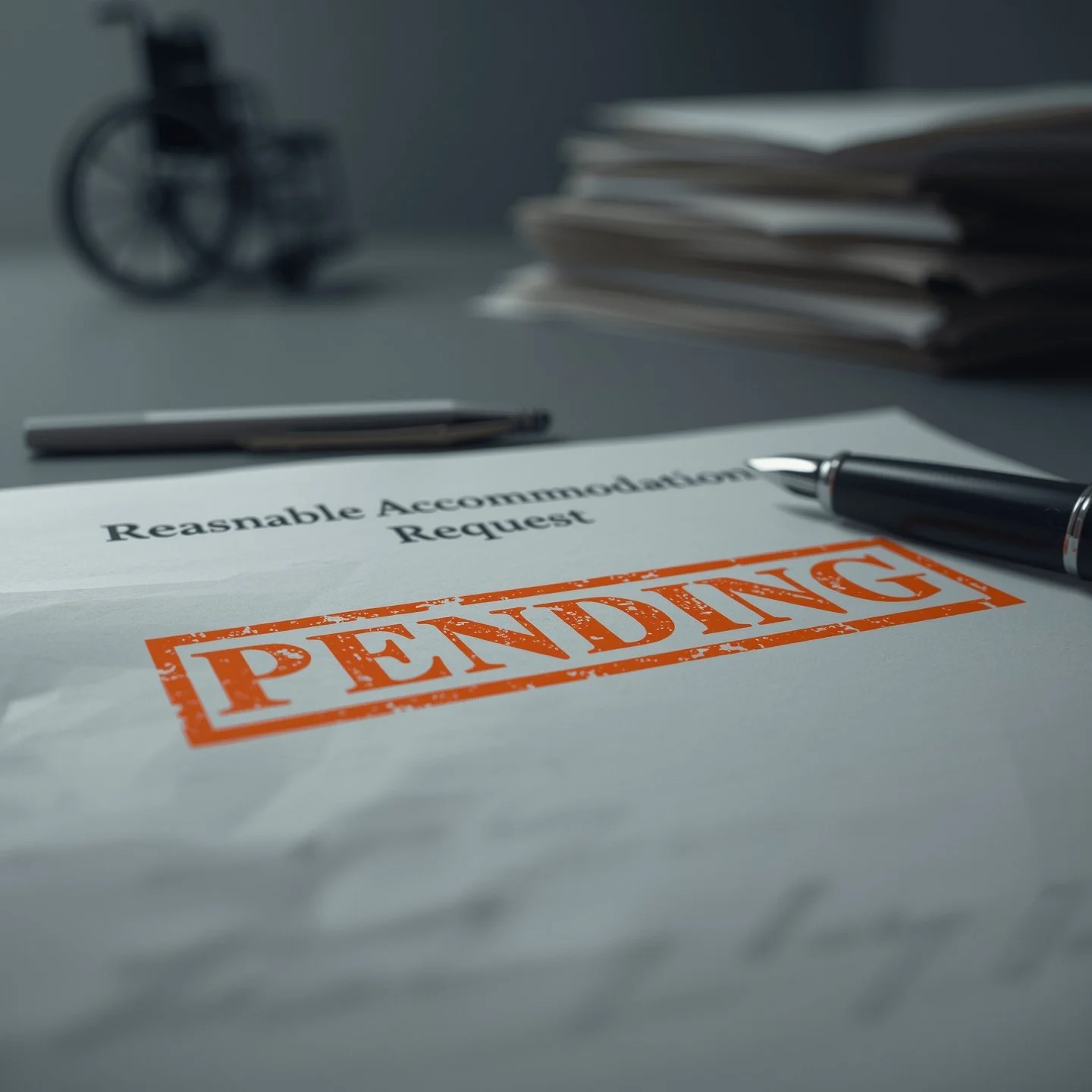
Close-up of a Reasonable Accommodation Request stamped PENDING, with a pen on the desk and a blurred wheelchair in the background.

Here’s the thing about reasonable accommodations:

The law frames them as “reasonable.” The process calls them “interactive.” But depending on whether management engages in good faith, they can either be empowering… or soul-crushing.

For many disabled professionals, the first physical reaction is anxiety. Every ping in the inbox brings the dread of having to re-prove what has already been proven. The process can feel less like collaboration and more like erosion, slowly wearing people down. Whether leadership engages in good faith makes all the difference.

And here’s the painful truth: nothing changes about an employee’s ability to do their job. They’re still the stellar hire management believed in, still delivering results. The only shift is that they ask for support to keep doing the job well, and suddenly the ground moves beneath them. Trust erodes, and that’s gut-wrenching.

Disabled employees know this feeling: the endless re-justification, the sense of being undervalued, the quiet fear of not being believed.

And managers? Believe your employees when they ask for an accommodation. Make it easy. They’re not asking for special treatment, they’re asking for what they need to keep doing the job you already knew they could do. Extra scrutiny doesn’t help anyone. It breaks trust, fuels turnover, and makes good employees want to leave.

Work with your people, not against them. That’s how accessibility works.